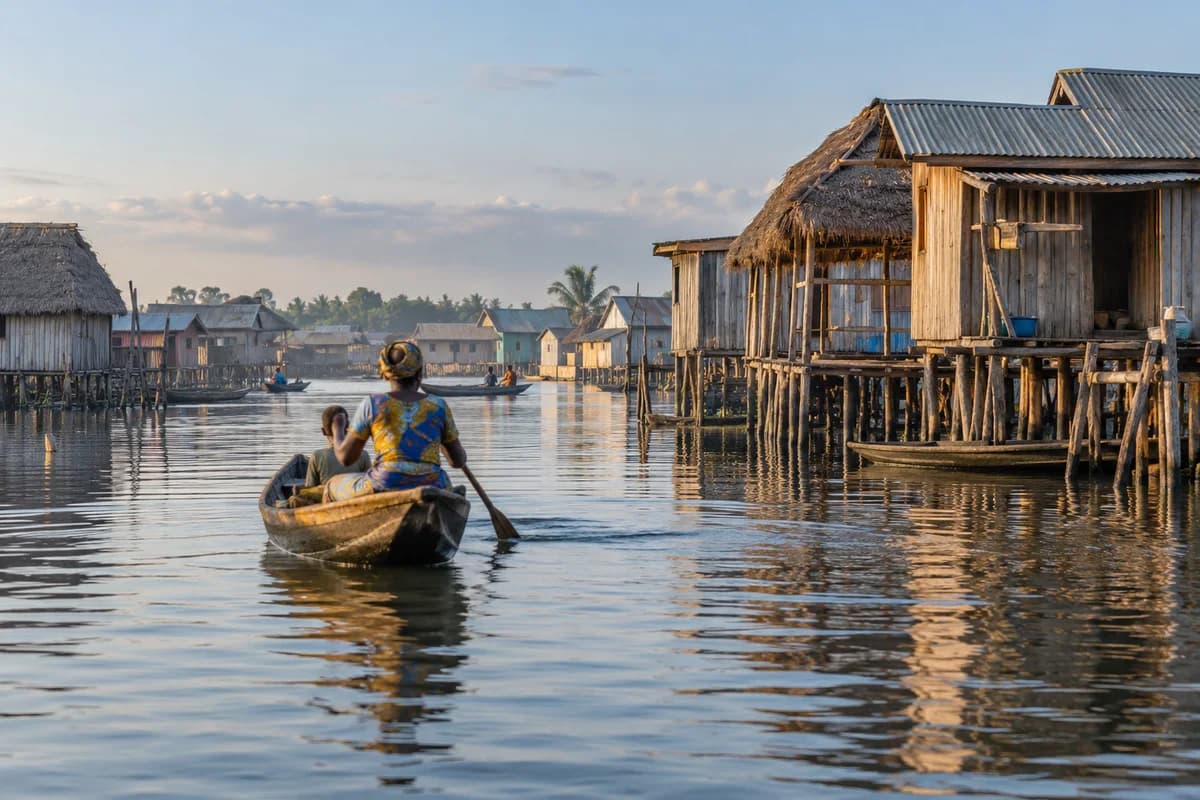
Ganvié lake village stands on Lake Nokoué, in the commune of Sô-Ava, north of Cotonou. Its houses on stilts, dugout canoes and fish parks tell a story of refuge and of life adapted to the water. Since March 2026 the site has been listed as national cultural heritage of Benin.
History of Ganvié lake village
Ganvié was founded by the Tofinu, a people living on the shores and waters of Lake Nokoué. Tradition links its founding to slave raids: by settling in the middle of the lake, families placed themselves beyond the reach of warriors who seized captives to sell to European slave traders.
Sources do not agree on the date. Some mention the 17th century, others the 18th. The researcher Fèmy Fagla places the first settlements in the 17th century and the development of stilt architecture in the 18th, at the height of the triangular trade.
The village has grown a great deal since then. According to figures quoted in The Conversation, it had about 10,700 inhabitants between the 1960s and 1980s and more than 37,000 in 2013.
What to see
The settlement is made up of 21 villages spread across the arrondissements of Ganvié 1 and Ganvié 2. People get around by dugout canoe: there are no streets and no cars, only channels between the houses.
- The stilt houses, originally built from plant materials and now often combined with corrugated iron and cement.
- The floating market, where goods are sold from canoes.
- The acadja, fish parks made of branches driven into the mud of the lake.
- Crafts using reeds and water hyacinth, and the mangroves that shelter many birds.
Since late 2025, new facilities have opened under the project "Réinventer la cité lacustre de Ganvié" (Reinventing the lake city of Ganvié), including a youth centre, a crafts centre and shelters for the floating market.
Living from the water: acadja fishing
The acadja is a traditional system. Fishers plant branches in the lagoon, in shallow water over muddy beds. The branches create an artificial habitat where fish find shelter and food, breed and grow.
According to the FAO, the main catch is tilapia, mullet and Chrysichthys. The same source notes that the authorities regulate the placing of acadja on Lake Nokoué to prevent uncontrolled occupation of the water.
Fishing, fish farming and canoe trade remain at the heart of the village economy, alongside tourism.
A living heritage to protect
On 4 March 2026 the Council of Ministers adopted Decree No. 2026-057, listing the "Cité lacustre de Ganvié" as national cultural heritage. The government points to rapid change: population pressure, new ways of life, lake pollution, damage to ecosystems and the effects of climate change.
The protected area covers about 481.85 hectares. Any rebuilding, major alteration or new construction now requires prior permission from the minister responsible for culture.
Ganvié was placed on Benin's UNESCO Tentative List in 1996. It no longer appears on the current list, which includes other Beninese sites.
Planning your visit
Ganvié is reached by dugout canoe or motorboat from the landing stage at Abomey-Calavi, on the shore of Lake Nokoué. Use a recognised local guide: Belgium's Federal Public Service Foreign Affairs advises using approved guides to avoid unpleasant surprises. Ganvié is a place where people live, not a backdrop: always ask permission before photographing anyone, as the Belgian travel advice stresses. Opening times and prices are not published by any official source; ask locally or through your guide.
Opening hours and prices can change: check locally or with the tourist office before you go.
Sources
- Secrétariat général du Gouvernement du Bénin, décret n° 2026-057 du 4 mars 2026
- Compte rendu du Conseil des ministres du 4 mars 2026
- Banouto, « Ganvié classé patrimoine culturel national » (16 mars 2026)
- Banouto, « Cité lacustre de Ganvié : bientôt un nouveau visage grâce à l'AFD » (10 novembre 2025)
- The Conversation, F. Fagla, « Bénin : pourquoi la cité lacustre de Ganvié perd son authenticité ? » (2023)
- FAO, profil de la pêche et de l'aquaculture du Bénin (acadja)
Checked in September 2026.