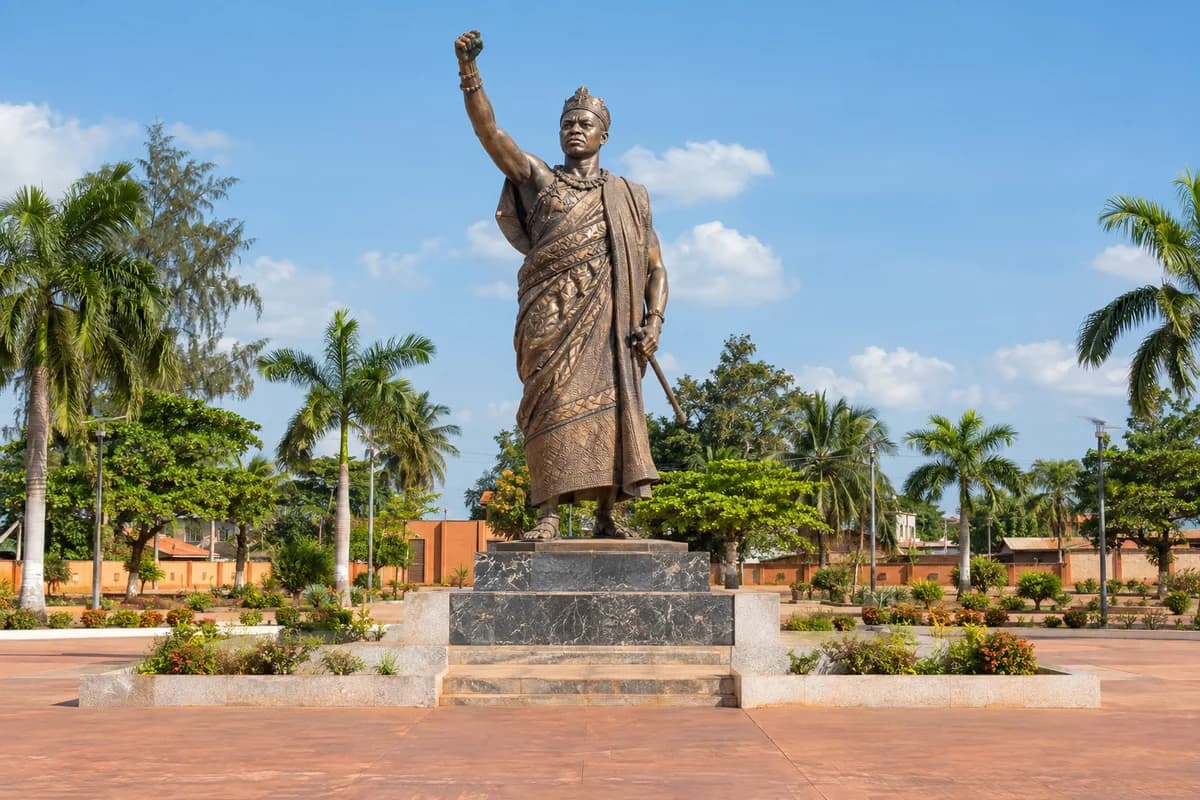
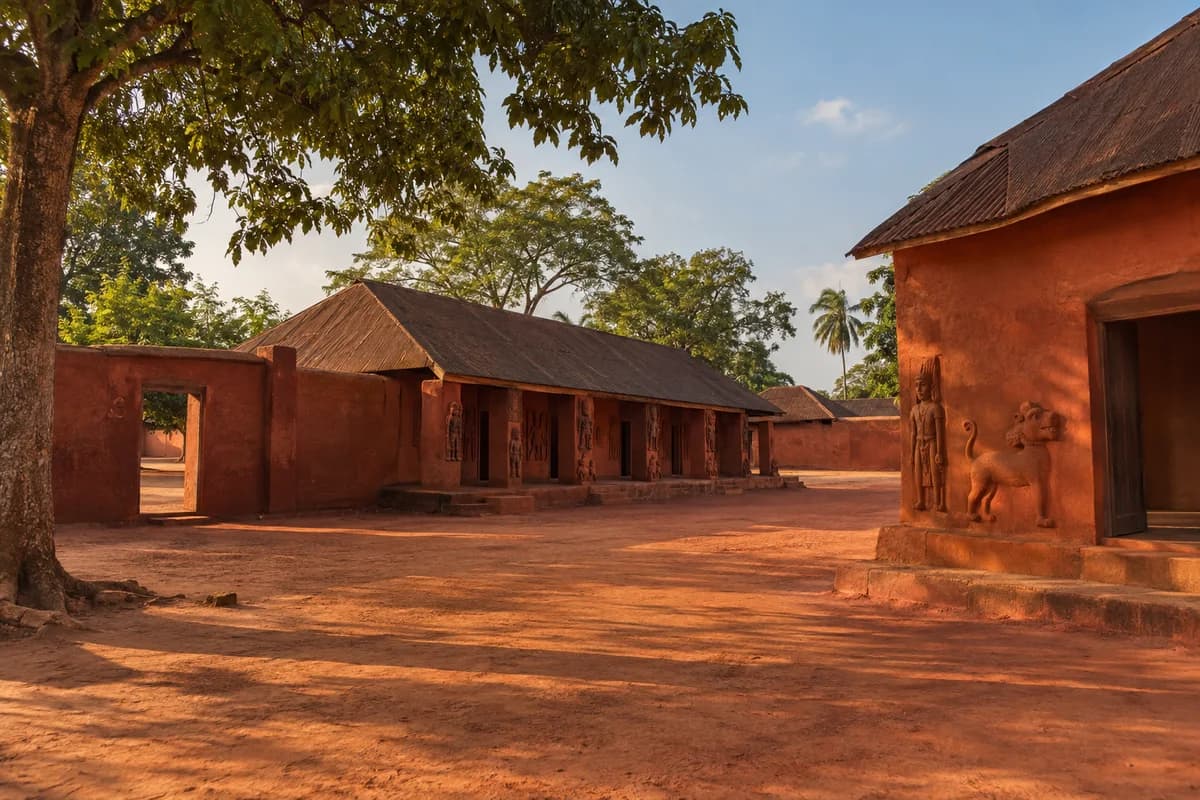
The Royal Palaces of Abomey are the historic heart of the kingdom of Danxomè, called Dahomey in colonial texts. Inscribed on the UNESCO World Heritage List in 1985, they cover 47.6 hectares in the centre of Abomey. Their earthen walls and bas-reliefs tell nearly three centuries of royal history.
History of the Royal Palaces of Abomey
According to UNESCO, twelve kings ruled the kingdom of Abomey between 1625 and 1900. Its founder, Houégbadja (reigned 1645-1685), is said to have laid down a precept his successors followed: "that the kingdom shall always be made greater". Danxomè thus became one of the most powerful states on the west coast of Africa.
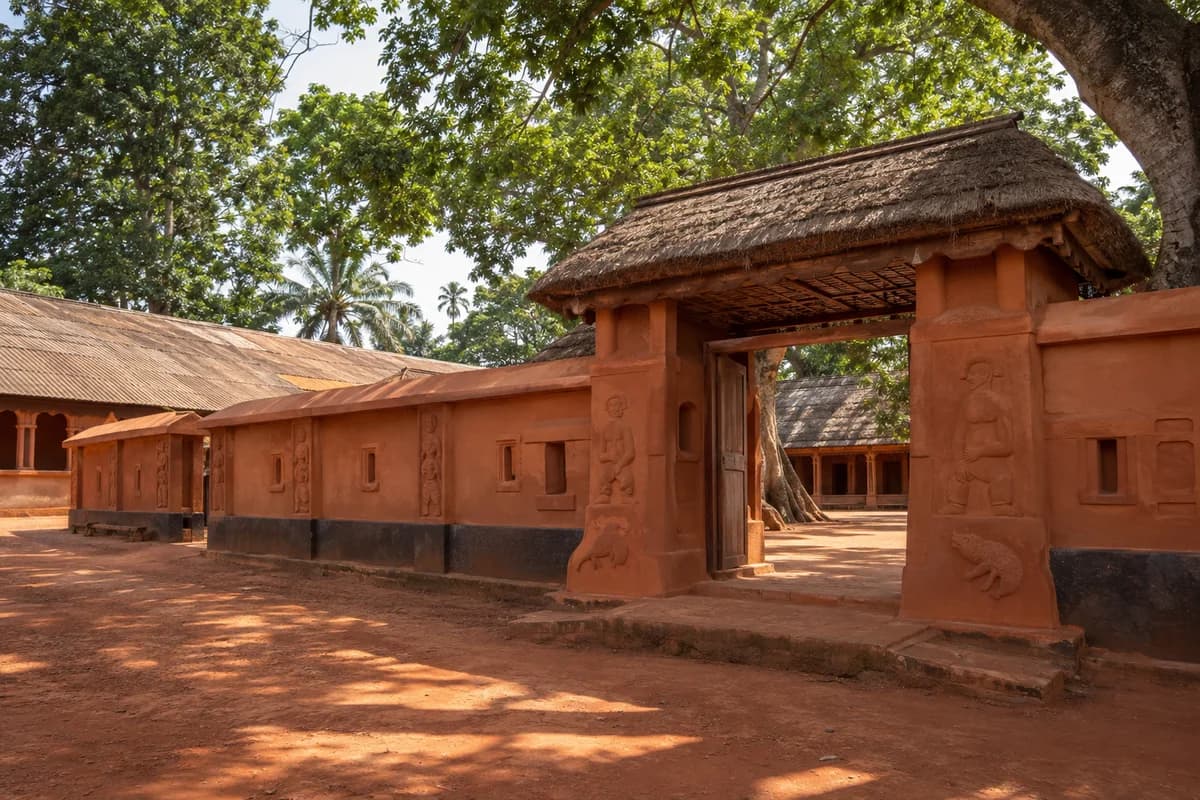
Each king had his own palace built within a large enclosure of earthen walls, next to or on top of that of his predecessor. Only King Akaba used a separate enclosure, divided from his father's by a street and houses. The site today includes ten palaces, each arranged around three courtyards: outer, inner and private.
In November 1892, during the French conquest led by General Dodds, King Béhanzin ordered the palaces to be set on fire rather than left to the enemy. On 17 November 1892 the French flag was raised over the Singbodji palace. The colonial administration began restoration work from 1911, and a historical museum was founded in the 1940s.
What to see
The palaces of Kings Guézo and Glèlè house the Abomey Historical Museum. It presents the history of the kingdom and its symbolism, marked by a will for independence and resistance to colonial occupation.
The polychrome earthen bas-reliefs are one of the defining features of this architecture. They depict legends, battles and the great deeds of the dynasty. In the mid-1990s, Benin's Ministry of Culture and the Getty Conservation Institute ran a four-year conservation programme for these panels, documented in a book published in 2000.
- the djexo, huts sheltering the spirit of the kings, and the adoxo, royal tombs, still maintained with traditional materials;
- Singbodji square, placed on UNESCO's Tentative List as the place where captives were sorted before being sent to Ouidah;
- King Béhanzin's palace, restored with UNESCO support.
World Heritage: danger and safeguarding
Damaged by a tornado in 1984, the palaces were inscribed in 1985 on both the World Heritage List and the List of World Heritage in Danger. An inventory carried out in 1995 recorded 184 components, and the property's area was revised from 44 to 47 hectares.
On 25 June 2007, meeting in Christchurch, the World Heritage Committee removed the site from the List in Danger. It recognised the progress of the conservation plan, partly funded by the World Heritage Fund. That same year Benin adopted Law No. 2007-20 of 23 August 2007 on the protection of cultural heritage.
The site remains fragile, as it is built of earth, wood and straw. On 21 January 2009 a bushfire destroyed the roofs of six huts, including two temples for offerings to Agasu and the tombs of Kings Agonglo and Guézo. A management council now brings together the town hall, the royal families, specialists and the State.
Returned treasures and a new museum
In 1892 colonial troops took many objects from the palaces to France. Following a report submitted in November 2018 and a law passed on 24 December 2020, 26 works from the royal treasures of Abomey (statues, thrones, doors) were returned to Benin. A ceremony was held on 27 October 2021 at the Musée du quai Branly-Jacques Chirac, and the transfer deed was signed at the Élysée on 9 November 2021.
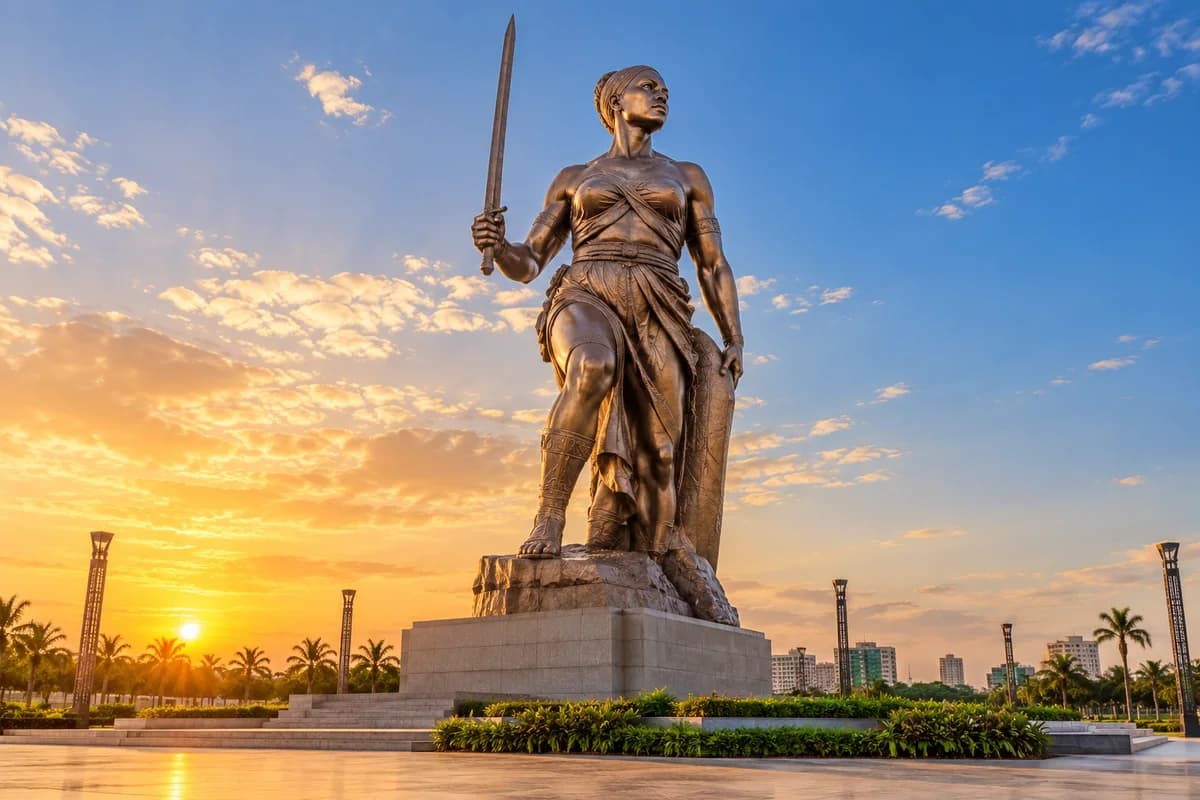
To house them, Benin and the French Development Agency (AFD) launched on 3 June 2021 the project for the Museum of the Epic of the Amazons and Kings of Danxomè (MuRAD), with 35 million euros of AFD funding. In April 2023 the Beninese government announced a total budget of 30 billion CFA francs and the rehabilitation of the palaces of Guézo, Glèlè, Béhanzin, Agoli-Agbo and Akaba, as well as that of Queen Hangbè.
The opening date of the new museum has been postponed several times. Before you travel, check the progress of the works and which areas are open.
Planning your visit
Abomey lies about 150 km north of Cotonou. A tour with a museum guide helps you read the bas-reliefs and understand how the courtyards are organised. The djexo, the royal tombs and other sacred places are still respected by the royal families: follow the instructions given on site. Opening hours, prices and photography rules are not published officially and up to date; ask at the museum reception or the tourist office, especially as rehabilitation works are under way.
Opening hours and prices can change: check locally or with the tourist office before you go.
Sources
- UNESCO, Centre du patrimoine mondial : Palais royaux d'Abomey (fiche 323)
- UNESCO : retrait de la Liste du patrimoine mondial en péril (25 juin 2007)
- UNESCO : incendie aux Palais royaux d'Abomey (13 février 2009)
- Élysée : les 26 œuvres des trésors royaux d'Abomey sont revenues au Bénin (2021)
- AFD : musée de l'épopée des amazones et des rois du Danhomè (3 juin 2021)
- Gouvernement du Bénin : site palatial d'Abomey, grand musée et palais réhabilités (2023)
Checked in September 2026.