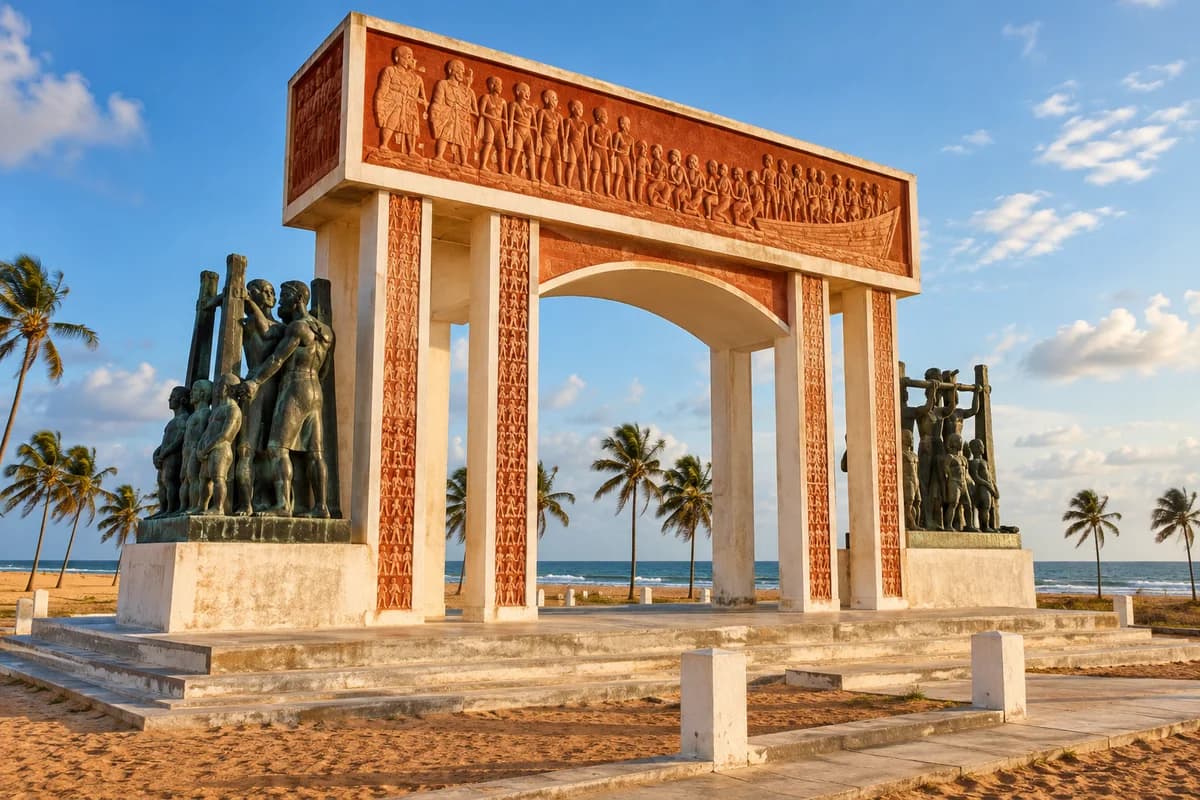
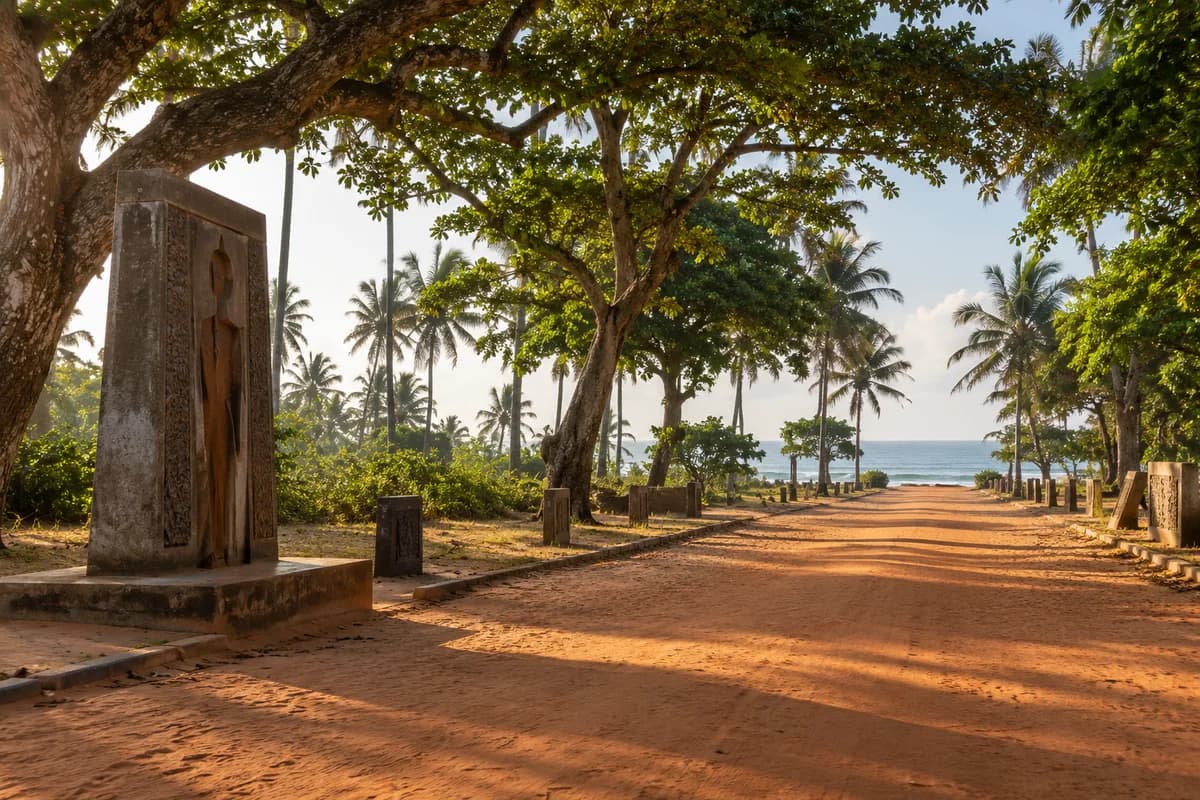
The Slave Route of Ouidah runs for about four kilometres from the former auction square in the town centre to the beach where the Door of No Return stands. Lined with monuments and works by Beninese artists, it recalls the last stages forced upon captives before their deportation to the Americas.
History of the Slave Route of Ouidah
In the 18th century, Ouidah was one of the major ports of the Atlantic slave trade on the 'Slave Coast'. The trading post first belonged to the Xwéda kingdom. After Danxomè conquered the town in 1727, under King Agadja, the Fon ran the trade with the Portuguese, French, English and Dutch forts.
According to the historian Robin Law, quoted in a study published by the University of Liège, more than one million captives left Ouidah for the Americas. The file submitted by Benin to UNESCO recalls that the slave trade shaped the whole history of Danxomè, from the reign of Agadja to that of Guézo.
The present trail is a work of remembrance. It was marked out for the 'Ouidah 92' festival, held in February 1993 at the initiative of President Nicéphore Soglo. On 1 September 1994, Ouidah hosted the launch conference of the UNESCO project 'The Slave Route', which aims to 'break the silence' on the slave trade and slavery.
The six stages of the trail
From the town centre to the ocean, the trail has six main stages:
- The auction square, also called Place Chacha, which recalls the sale of captives. The name refers to the slave trader Francisco Félix de Souza (1754-1849), known as Chacha, whose descendants still live beside the square.
- The Tree of Forgetting, linked to a ritual meant to make captives forget their roots.
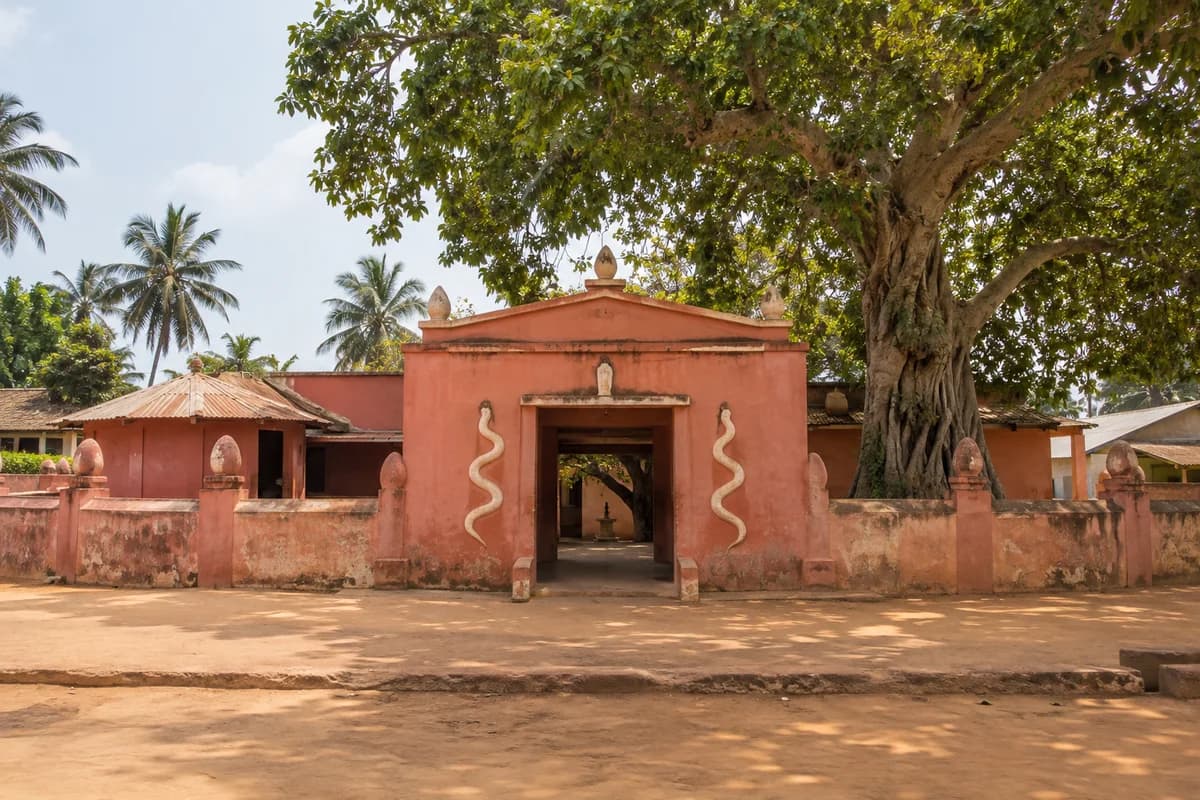
- The Zomaï hut, where captives were locked up until the ships arrived.
- The Zoungbodji memorial, which marks the mass grave into which dead captives were thrown.
- The Tree of Return, linked to the ritual believed to let the souls of the deported return to their homeland after death.
- The Door of No Return, on the beach, which recalls boarding the ships.
Most of the original sculptures are by Cyprien Tokoudagba. Dominique Kouas made the statues at the Zomaï hut and of Mami Wata. The Zoungbodji memorial is the work of Fortuné Bandeira and the Dakpogan brothers.
Meaning and memory
The route is not a path preserved unchanged. It is a symbolic itinerary: the historian Robin Law has questioned the historical accuracy of some stages. Its strength lies in giving the memory of the deported a place.
The trail has changed over time. In 1998, the Zomachi memorial was built next to the Zomaï hut. In 1999, the municipality restored the auction square with German cooperation. The works have also suffered: objects once held by some statues have gone, and several explanatory texts have been erased.
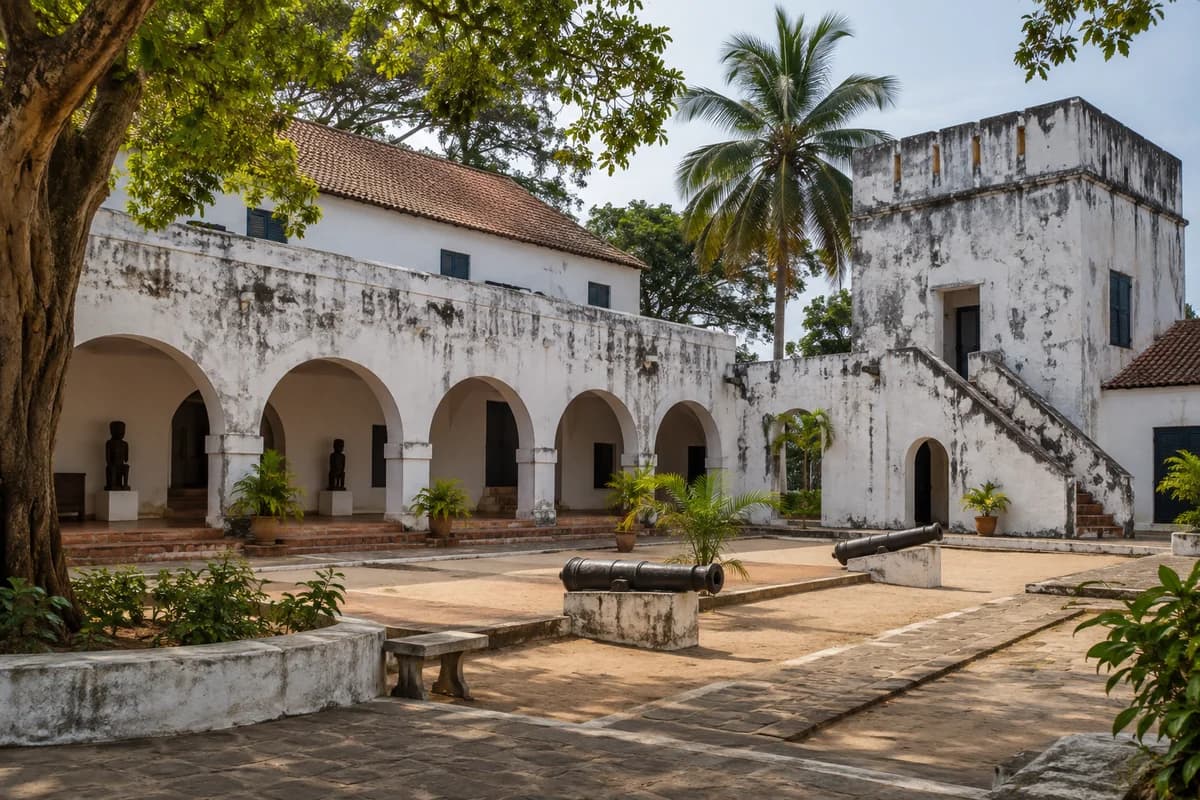
In 2021, Benin added a serial property to its UNESCO Tentative List, Sites marquants de la Route de l'Esclave au Bénin. In Ouidah it includes the auction square, the Portuguese fort, the sites of Zoungbodji village and the Djègbadji landing place, where the Door of No Return stands.
A trail being redeveloped
Benin's national heritage and tourism agency, ANPT (Agence nationale de promotion des patrimoines et de développement du tourisme), is leading the faithful reconstruction of the historic town of Ouidah, funded by the World Bank. It covers the restoration of the auction square, the Zoungbodji memorial, the Tree of Return and the Door of No Return, as well as the building of the slave route from the auction square to the beach.
At the end of 2024, the Beninese press reported works along the whole route, from the auction square past the Tree of Forgetting to the Door of No Return. ANPT also plans later works on the Zomaï hut and the French fort.
Planning your visit
Ouidah lies some forty kilometres west of Cotonou. The trail starts at the auction square in the centre and leads down to the beach. Some explanatory texts have gone, so a local guide helps to understand each stage and its history. The route is a place of remembrance; a quiet, respectful attitude is expected, especially at the memorials. Redevelopment works are under way: ask locally about access to the different stages.
Opening hours and prices can change: check locally or with the tourist office before you go.
Sources
- UNESCO, liste indicative : Sites marquants de la Route de l'Esclave au Bénin (2021)
- R. Goussanou, « La Route de l'esclave de Ouidah », Cahiers Mémoire et Politique, Université de Liège
- UNESCO, 20e anniversaire du projet La Route de l'esclave
- ANPT, Projet Ouidah : reconstruction à l'identique de la cité historique
- Le Béninois Libéré, réhabilitation de la Route de l'Esclave (décembre 2024)
Checked in September 2026.