Free schooling for girls now applies across Benin's public secondary education. Since the school year began on 14 September 2026, every girl enrolled from the 6e (first year of secondary) to the terminale (final year), in public general or technical education, no longer pays school fees. The measure applies in all 77 municipalities.
It comes with other social measures for all three levels of education. Here is the full picture.
A Council of Ministers decision of 3 June 2026
The measure was adopted at the Council of Ministers of 3 June 2026, a few days after President Romuald Wadagni took office. The official record is clear: free schooling in public general and technical secondary education “sera effective pour toutes les filles sur toute l'étendue du territoire” (will apply to all girls throughout the country) from the 2026-2027 school year.
Government spokesperson Wilfried Léandre Houngbédji summed it up at his press conference on 5 June:
« De la maternelle en terminale, quand on est dans l'école publique, nos filles ne paient rien. » (“From nursery school to the final year, in public schools, our girls pay nothing.”)
The government relies on the Constitution, which provides that the State shall progressively make public education free. It also stresses that girls have the same potential as boys.
Free schooling for girls: a step-by-step extension
The 2026 decision completes a long-standing policy of free schooling for girls. Girls in the lower secondary cycle (6e to 3e) were already exempt from school contributions. In 2023, an order of 17 April extended the exemption, on a trial basis, to the upper cycle in twenty municipalities.
| Stage | Classes | Coverage |
|---|---|---|
| Before 2023 | Lower cycle (6e to 3e) | Whole country |
| Order of 17 April 2023 | Upper cycle (2de to terminale) | Twenty municipalities |
| 2026-2027 school year | 6e to terminale | 77 municipalities |
How schools are compensated
An interministerial order of 30 July 2026, signed by ministers Clément Kouchadé (Secondary Education) and Aristide Médenou (Economy and Finance), sets out the scheme. It replaces the 2023 trial order.
Free schooling for girls must not weigh on school budgets. Public secondary schools receive the amount of the exemption granted as compensation. This amount is calculated from validated numbers of girls and the contribution rates in force. To keep schools running, cash advances are paid at the start of the school year. They are later settled from the budget of the ministry in charge of secondary education.
The social measures of 2 September 2026
Ahead of the new school year, the Council of Ministers of 2 September 2026 adopted a package of measures for all three levels of education. Their total cost comes to around 30 billion CFA francs.
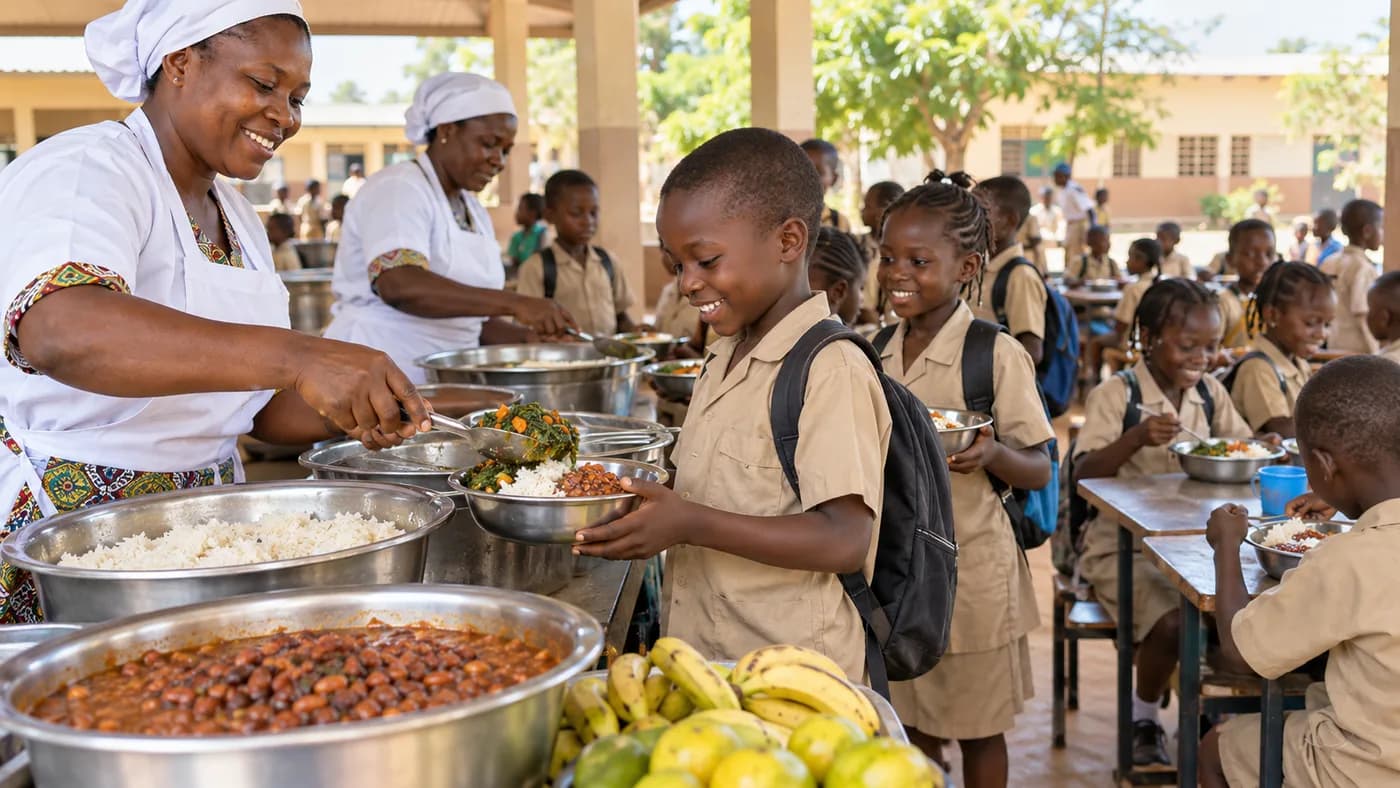
- Nursery and primary: school canteens expand from 1.4 to 1.9 million pupils, and an emergency plan keeps teaching going in border areas affected by insecurity.
- Secondary: rebuilding of the Abomey girls' lycée, works in the girls' lycées (Lokossa, Natitingou, Ouidah, Parakou, Porto-Novo), refurbishment of the military lycées of Bembèrèkè and Natitingou, production of 12,000 desk-benches.
- Higher education: grants raised by up to 49% depending on the course, 63 new buses, refurbished university canteens in Dangbo, Lokossa and Parakou, new canteens in Abomey-Calavi and Kétou, equipped infirmaries.
Inclusion: girls in technical courses and students with disabilities
Two measures focus on inclusion. Enrolment of girls in technical secondary courses becomes free, “to encourage them”. In addition, every baccalaureate holder with a disability receives a grant for the 2026-2027 academic year.
The Council of Ministers of 3 June had already released 20 billion CFA francs to connect public schools lacking drinking water or electricity.
On the ground: Minister Kuyema Natta's tour
Classes resumed on 14 September 2026, after a preparatory week from 7 to 11 September. The year has three terms. On 1 and 2 October, the Minister of Nursery and Primary Education, Armand Kuyema Natta, made unannounced visits in the Atlantique, Zou, Mono and Couffo departments.
He spoke with pupils, teachers and head teachers. The problems raised concern infrastructure and teacher shortages. According to the minister, these concerns “will be analysed and reported to the Government”.
What changes for Beninese families in Belgium
Free schooling for girls directly concerns families considering a return. A family moving back to Benin with a daughter of secondary school age will no longer pay school fees in the public system. To understand the cycles and exams, read our article on the education system in Benin and our guide on moving back to Benin.
The other way round, a pupil arriving in Belgium with a Beninese diploma often needs to have its level recognised. Our guide on diploma equivalence explains the procedure. On school meals, see also our article on school canteens.
Sources
- General Secretariat of the Government: Council of Ministers record, 3 June 2026; Council of Ministers record, 2 September 2026
- Government of Benin: Minister Armand Kuyema Natta's tour
- Le Matinal: The government explains the measure; Free schooling extended to all girls
- La Météo: How the State funds public schools
- Banouto: School year starts on 14 September
Article tags