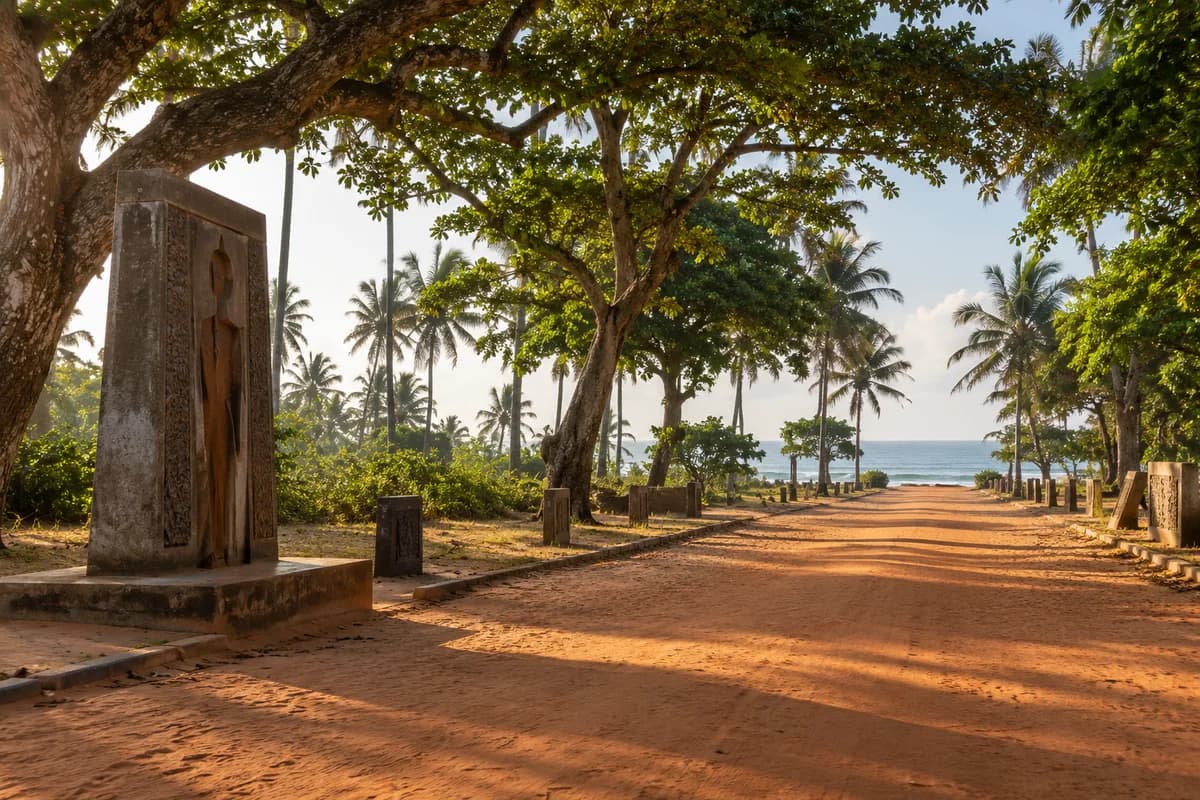
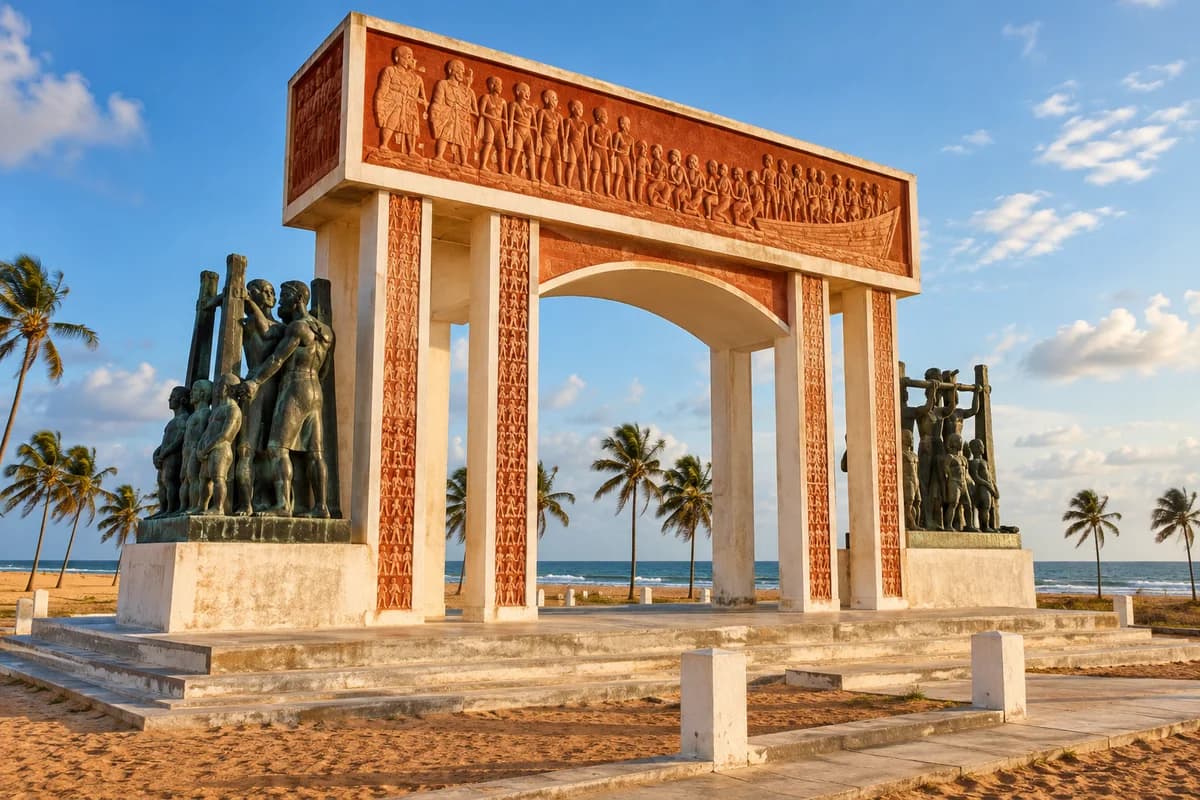
The Door of No Return stands on the beach at Ouidah, at the end of the Slave Route. Unveiled in 1995, it honours the captives deported to the Americas from this shore. At the end of 2025, a new and taller gate replaced the original monument.
History of the Door of No Return
The gate was unveiled on 30 November 1995. It became the last stage of the memorial trail opened in Ouidah for the 'Ouidah 92' festival, held in 1993. The project was backed by the Beninese government and by UNESCO, which had launched its 'Slave Route' project in Ouidah in September 1994.
It is a collective work. According to the Fondation pour la mémoire de l'esclavage, several Beninese artists worked under the architect Yves Ahouangnimon. Fortuné Bandeira made the columns and their reliefs. Dominique Kouas produced the bronze and copper elements. Yves Apollinaire Pédé carved the reliefs of the central arch and the egungun statues.
The monument stands on Djègbadji beach. In its 2021 Tentative List, Benin identifies this spot as the slave-trade landing place, the last Ouidah component of the property 'Sites marquants de la Route de l'Esclave au Bénin'.
What the 1995 arch showed
The original arch, in concrete painted red, white and yellow, combined bronze and copper. A frieze showed two lines of captives, hands bound and chained to one another, walking towards the ships. On the columns, shackled men and women knelt and waited. On the back, the artists depicted the home towns of the deported.
Egungun statues surrounded the monument. In Yoruba culture, these figures of 'returning spirits' evoke the return of souls to their families. Doves also framed the gate; they disappeared less than ten years after they were put up.
A new Door of No Return in 2025
The gate is part of the project to rebuild the historic town of Ouidah, led by ANPT and funded by the World Bank. According to the agency, the artistic work involves Fortuné Bandeira, the Pédé brothers and Dominique Gnonnou, known as Kouas, three names already linked to the 1995 monument.
In December 2025, the Beninese press presented the new monument. It is a concrete gate 16.32 metres high and 23 metres long, adorned with more than two hundred hand-made sculptures. It replaces the 1995 structure and was a centrepiece of the Vodun Days in January 2026.
The surroundings have been redesigned: a wide planted ramp leads to the monument, the ground is paved with Beninese granite and a large seating area faces the ocean.
Meaning and memory
The Door of No Return evokes the departure without return of captives torn from their land and shipped to the Americas. It does not mark a surviving historic building: it is a symbolic monument, set where local memory places the embarkation.
A few hundred metres away, the Zomachi memorial opened a space called 'La Porte du retour' (the Door of Return). It answers the Door of No Return and is addressed to the descendants of the deported. Together, these places recall that the slave trade bound Africa, Europe and the Americas for centuries.
Did you know?
- The conference that launched the UNESCO project, on 1 September 1994 in Ouidah, had the theme 'From the slave trade to development: reflecting on the conditions for lasting peace'. It was opened by President Nicéphore Soglo and by UNESCO's Director-General, Federico Mayor.
- In 2014, the Abomey-born artist Arolando set up below the gate a work entitled Commerce triangulaire (Triangular Trade), made from salvaged materials.
- The beachfront has long been coveted. A bungalow scheme reaching right up to the gate, although well advanced, was halted by the authorities.
Planning your visit
The gate stands on the beach at the end of the Slave Route, about four kilometres from the centre of Ouidah, a town some forty kilometres west of Cotonou. To grasp its meaning, it is best reached by following the trail from the auction square with a local guide. It is a place of reflection: please keep a respectful attitude, especially during commemorations.
Opening hours and prices can change: check locally or with the tourist office before you go.
Sources
- Contemporary Monuments to the Slave Past, La Porte du Non Retour
- Fondation pour la mémoire de l'esclavage, La Porte du Non-Retour
- R. Goussanou, « La Route de l'esclave de Ouidah », Université de Liège
- ANPT, Projet Ouidah
- Le Grand Mono, « Ouidah : la Porte du Non-Retour fait peau neuve » (décembre 2025)
- UNESCO, liste indicative : Sites marquants de la Route de l'Esclave au Bénin (2021)
Checked in September 2026.