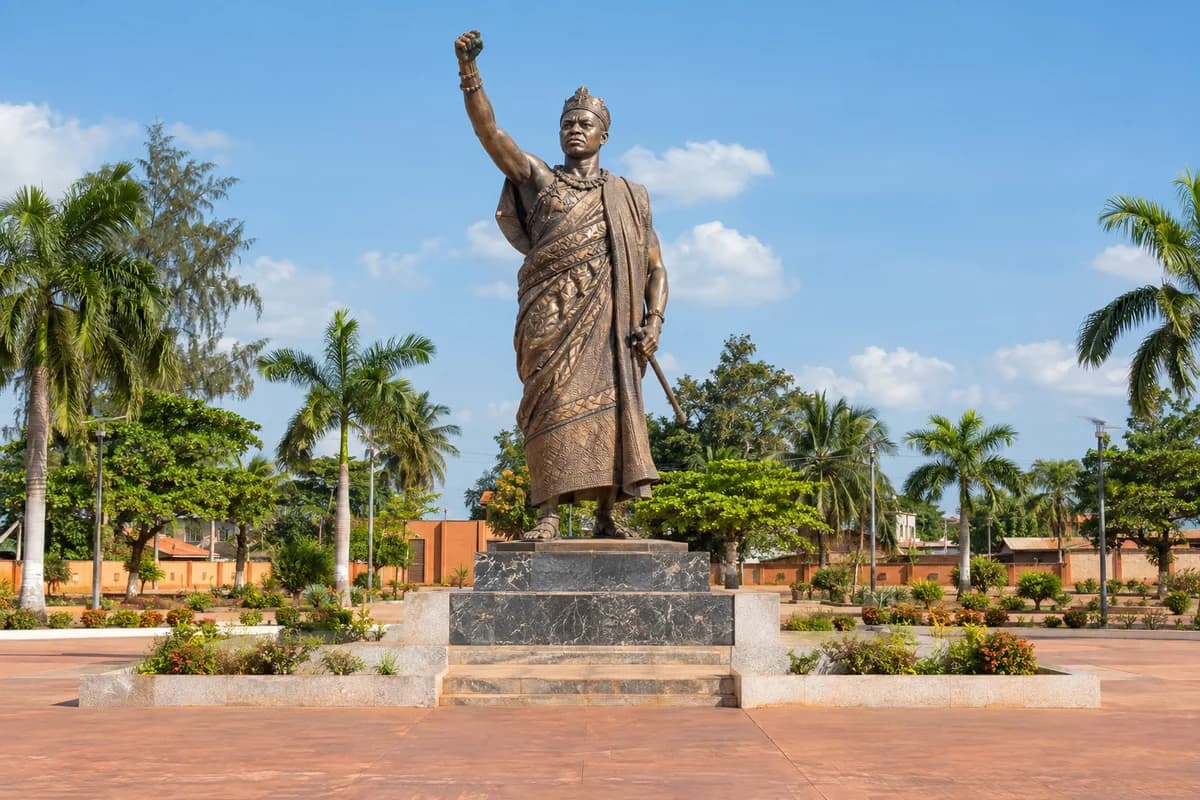
The Béhanzin statue stands on Goho Square, in the centre of Abomey. It honours the king of Danxomè who led the resistance to French conquest until 1894. The place itself carries the memory of the end of the independent kingdom.
Béhanzin, king of the resistance
Born around 1845 as Prince Kondo, Béhanzin (or Gbèhanzin) succeeded his father Glèlè and ruled Danxomè from 1890. His personal emblem combines an egg, a shark and two coconut palms. The shark stands for the king's boldness towards the Europeans.
Béhanzin refused treaties that would have placed the kingdom under foreign control. France fought two wars against him. In November 1892 General Dodds's expeditionary force reached Abomey; the king had his palaces burned and continued the fight.
He surrendered to French troops at Goho in January 1894. Sources differ on the exact date: some give 15 January, others 25 January 1894. France then placed his brother Agoli-Agbo on the throne.
Exile and return
According to his son's account, Béhanzin believed he was being taken to France to meet the President of the Republic. In reality he was deported to Martinique in 1894, first held at Fort Tartenson and then placed under house arrest. That promise was never kept.
In 1906 he was transferred to Algeria. He died in Algiers on 10 December 1906. Only in 1928 did the French government allow his family to bring his remains back to Abomey, where he was buried with honours.
Goho Square and the Béhanzin statue
According to the Beninese daily La Nation, the square was once called Kpatinlin and was linked to King Glèlè's palace. It was at Goho that Béhanzin and General Dodds met for the surrender, and where Dodds set up his camp. In November 1974 the military revolutionary government delivered the "Goho speech" there, announcing its choice of Marxism-Leninism.
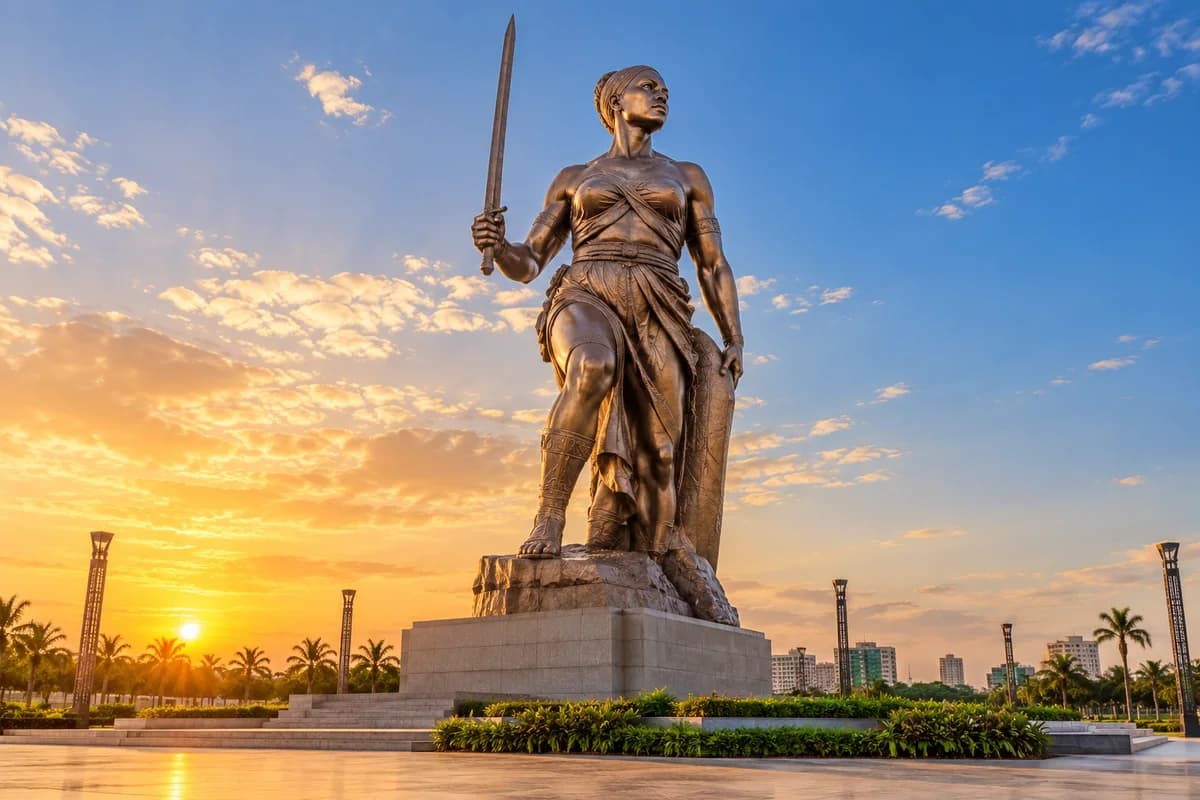
The copper-alloy statue stands over six metres tall. A note by Cleveland State University dates it to 1979 and attributes it to North Korea's Mansudae studio; other sources give 1978. The king wears royal regalia, including sandals reserved for sovereigns and the makpo sceptre.
The outstretched hand, palm forward, reads as a command to halt: the refusal to hand the land of the ancestors to the occupier. In front of the statue lie a fountain and a rectangular pool; around it, medallions display the emblems of the former kings.
Meaning and memory
For Beninese people, Goho Square brings several memories together: the fall of the independent kingdom, the resistance of a king and a key moment in the country's political history after independence.
Tradition attributes a frequently quoted sentence to Béhanzin: "The shark surrenders, but the sons of the shark will not betray." It sums up the image of a sovereign defeated by arms but not in his honour.
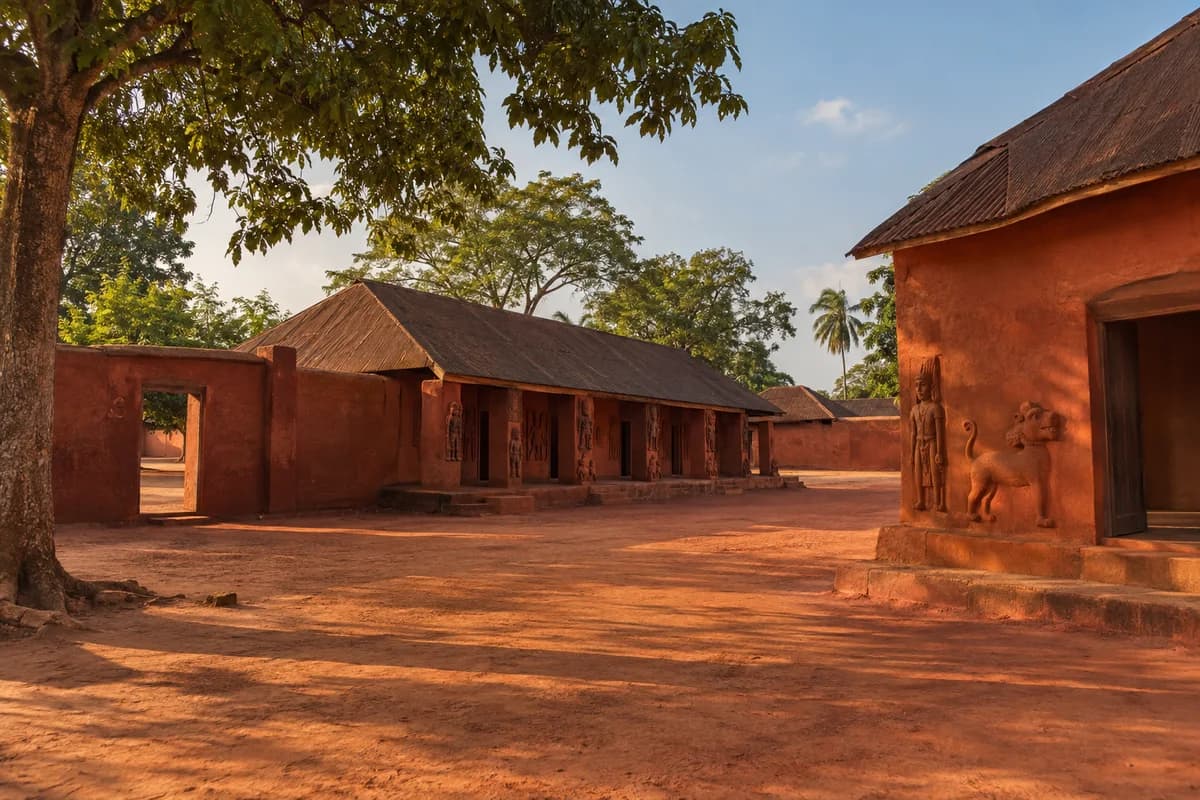
A visit to the square pairs naturally with the Royal Palaces of Abomey, where Béhanzin's palace stands, restored with UNESCO support. Together, the palace and the square tell the story of the last years of the independent kingdom.
Planning your visit
Goho Square is in central Abomey, about 150 km north of Cotonou, and is best visited together with the royal palaces. It is a public space: no official visiting rules are published. Respect the memorial character of the place and, for a fuller account of Béhanzin's story, go with a guide from the Abomey Historical Museum or ask at the tourist office.
Opening hours and prices can change: check locally or with the tourist office before you go.
Sources
- The Bright Continent (Cleveland State University) : Akhosu Behanzin, North Korean Style
- La Nation : Places publiques au Bénin, ces statues qui racontent l'histoire (15 mars 2023)
- Histoire coloniale et postcoloniale : la promesse trahie ou la déportation de Béhanzin
- Wikipédia : Béhanzin
- Wikipédia : Musée historique d'Abomey
Checked in September 2026.