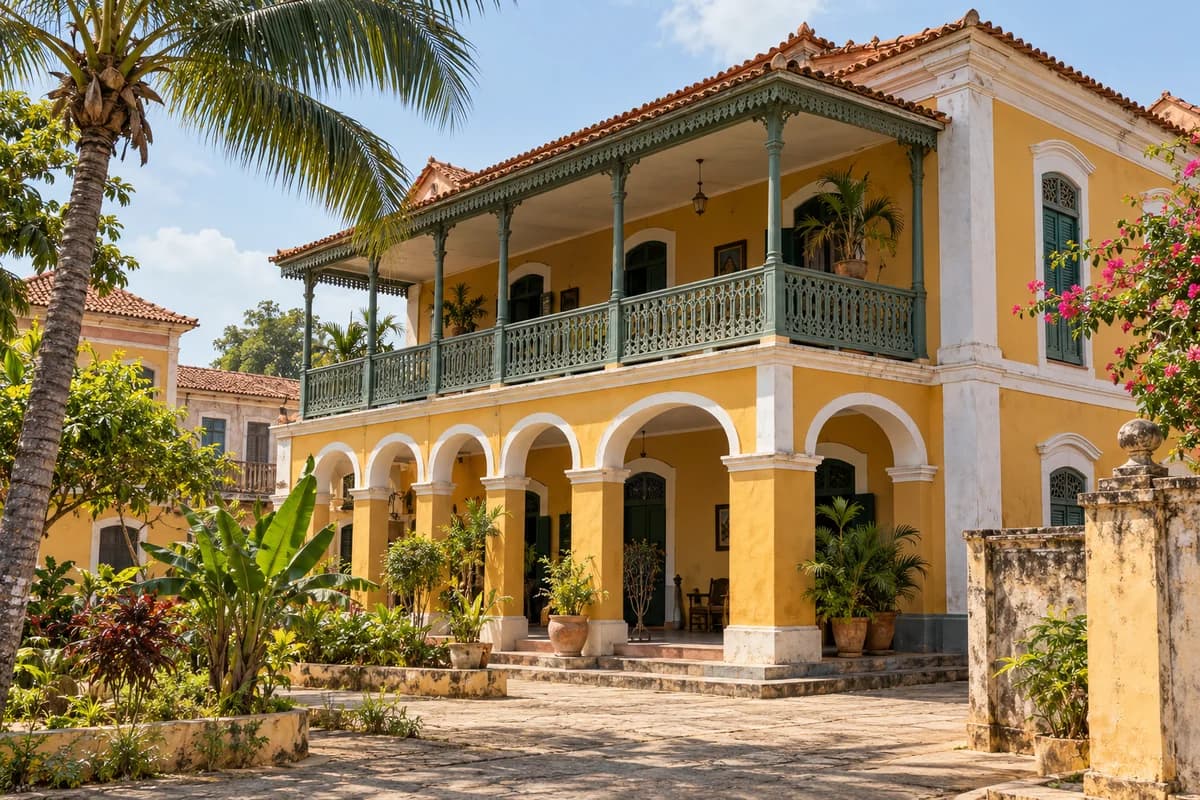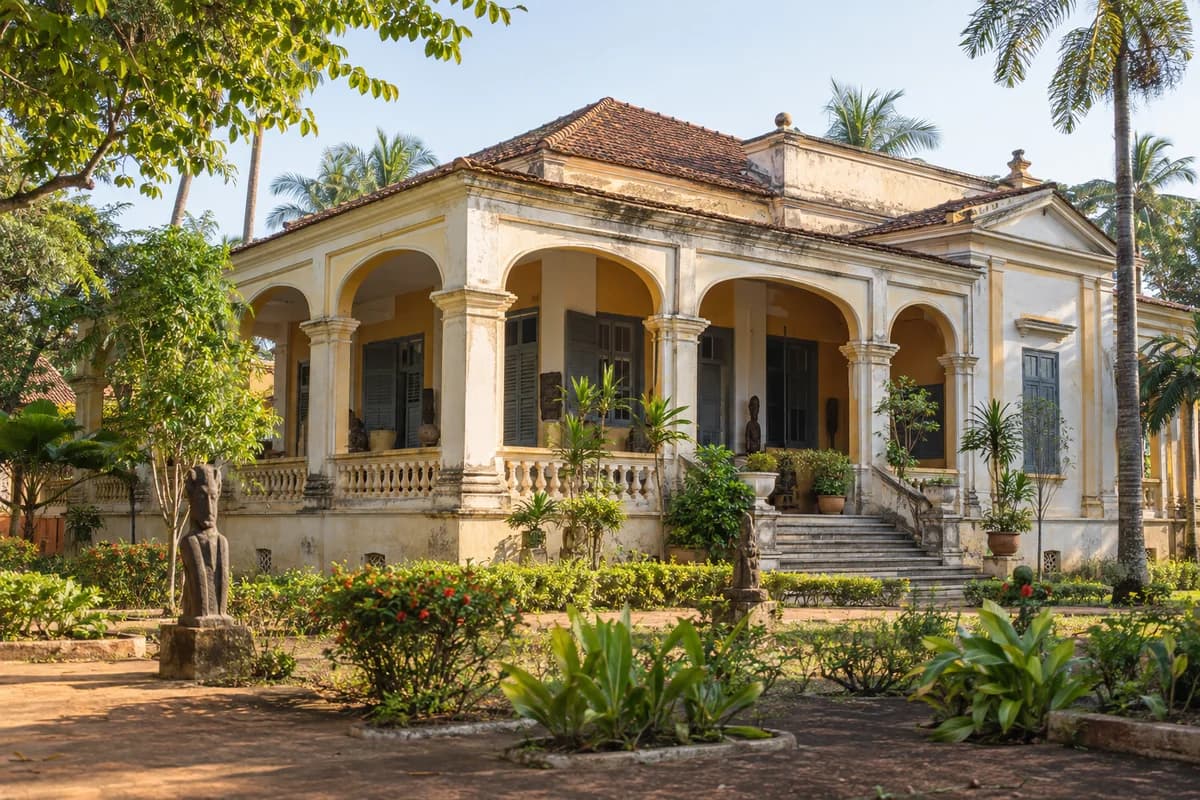
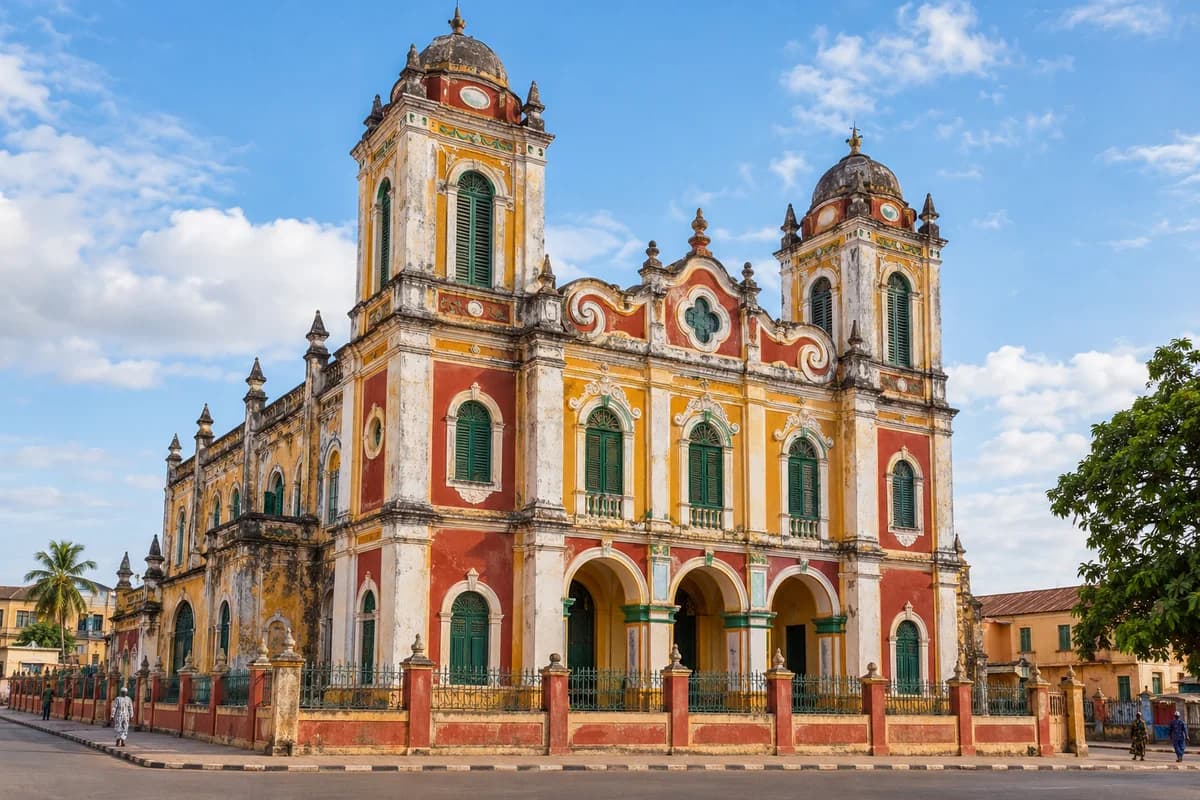
With its colourful façade, columns and arcades, the Great Mosque of Porto-Novo first looks like a baroque church. Built between the 1910s and 1935 beside the main market, it bears the mark of the Agudas, the Afro-Brazilian families who returned from Brazil. It remains one of the clearest witnesses to the town's Afro-Brazilian architecture.
History of the Great Mosque of Porto-Novo
Islam reached Porto-Novo in the 19th century with Hausa and Yoruba merchants from present-day Nigeria. Shortly after his accession in 1848, King Sodji appointed a single imam for the whole community and gave him land near the royal palace.
A first mosque was built there around 1880. It stood next to English trading houses, whose European staff complained to the king about the muezzin's call. Yet the community refused to pull it down. It only agreed in 1910, when the colonial authorities laid out a new road across the site.
The new mosque then rose on land given by an Afro-Brazilian, north of the central market. Work progressed as donations came in, with a subsidy from the colonial administration. Crises within the community halted it several times. In 1925 the administration took charge of the works. The building was only truly finished around 1935, then extended several times, above all from 1950 onwards.
Architecture from Bahia
Before settling on the plans, the community sent a delegation to Lagos to visit that city's main mosque. Like it, the new building follows the style of the churches of Salvador de Bahia in Brazil.
The work was carried out by builders drawn mostly from the Afro-Brazilian community, the Agudas. Descendants of freed slaves who had returned from Brazil and of the Portuguese community, they carried the Afro-Brazilian influence into the town's architecture.
The older part is built of fired brick and has two minarets. Its prayer hall spreads over two levels, ground floor and mezzanine. The façade has a gallery lined with carved columns beneath round arches. Inside, a large vault is decorated with stars and Arabic script.
What to see
By 1990 the mosque had three minarets and over 3,700 m² of tiled floors on two storeys. The extensions came in two phases: an east wing, with a minaret almost in line with the first two, then a more recent west wing.
The older part remains the most striking. Here you can read the transposed church front: columns, arches, many openings and ornamental motifs. A larger, modern mosque now stands next to the historic building.
Meaning and memory
The Great Mosque reflects the transformation of Porto-Novo after the abolition of slavery. The Agudas, back from Brazil, left an architecture that joins their Bahian heritage with the faith of the Muslim community.
The start of the works also prompted the Catholic community to begin a new, larger church in 1925. The old town can thus be read as a dialogue between places of worship.
The old quarters of Porto-Novo, where the mosque stands, have been on Benin's UNESCO Tentative List together with the royal palace since 1996.
Planning your visit
The mosque stands on Rue Victor Ballot, north of the main market in the Avassa district, close to the Honmè Museum. It is an active place of prayer: the façade can be viewed freely from the street, but entry depends on permission from those in charge. Wear covering clothes, remove your shoes and avoid prayer times, especially Friday midday.
Opening hours and prices can change: check locally or with the tourist office before you go.
Sources
- Steve Nicoué Kotey, Porto-Novo, la grande mosquée, patrimoine d'architecture afro-brésilienne, Archicaine (2013)
- Ayodeji Ogunnaike, The Transcontinental Genealogy of the Afro-Brazilian Mosque, MAVCOR Journal (Yale)
- Monwaih, La mosquée centrale de Porto-Novo, un joyau patrimonial
- Afrik.com, Porto-Novo : plongée dans la majesté de la mosquée centrale (2025)
- Wikipédia, Grande mosquée de Porto-Novo
Checked in September 2026.