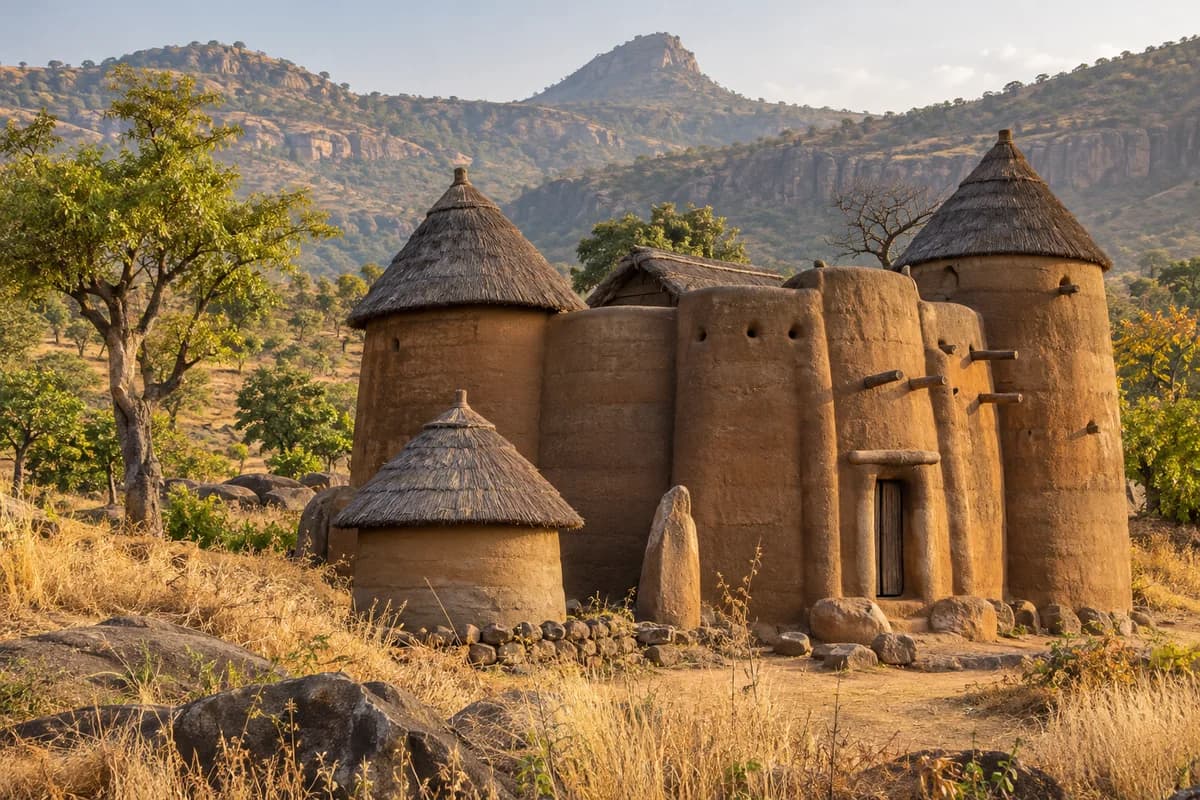
The Tata Somba of the Atacora are the earthen tower-houses of the Batammariba, called takienta (or takyenta) in their own language. They stand around Boukoumbé, Natitingou and Toucountouna, in north-western Benin. Since 2023 this landscape has been part of the World Heritage property "Koutammakou, the Land of the Batammariba", shared with Togo.
History of the land of the Batammariba
The name Batammariba means "those who shape the earth" in Ditammari, the language of the Otammari. The term "Tata Somba" is common in Benin; in Ditammari, one house is a takienta and several are sikien.
According to UNESCO, the Beninese part of Koutammakou holds the historical birthplace of the Batammariba, occupied since the 6th century, before their dispersal. The religious centres of Koubonku and Koubentiégou remain sacred places where major ceremonies and initiation festivals are held.
The Togolese part of Koutammakou has been on the World Heritage List since 2004. Benin placed its part on the Tentative List in 2020, and the World Heritage Committee added it to the property at its 45th session in Riyadh, in September 2023.
Architecture of the Tata Somba of the Atacora
The takienta is an earthen family house with circular or elliptical shapes. It serves a technical, practical and symbolic purpose all at once.
- On the ground floor, a space for the animals.
- On the roof terrace, the family granaries.
- All around, the fields, sacred groves and ritual and funerary spaces.
UNESCO stresses that no other dwelling in the region links symbol, function and technique so closely. The houses follow a cycle: building, abandonment, destruction and rebuilding on the ruins.
Meaning and memory
For the Batammariba, the takienta is far more than a home: it is a temple dedicated to the worship of ancestors. This is why many families, even next to modern tin-roofed houses, keep a traditional dwelling, sometimes smaller, with its granaries and space for animals.
The whole landscape carries this memory: caves, springs, sacred rocks, groves, ritual paths and initiation sites. The rites of passage for boys (difoini) and girls (dikuntri) are still observed, locally and in the diaspora.
Every year the Batammariba gather for a large festival held alternately in Benin (FACTAM) and Togo (FESTAMBER).
Protection and challenges
In Benin, the boundaries of the property are set by an interministerial order of 2020. It rests on Law No. 2007-20 of 23 August 2007 on the protection of cultural heritage. A management plan covers 2021-2025 and a management committee has been set up in the Atacora.
The challenges are real: the wood and straw needed for building are becoming scarce near the villages, and some of the younger generation are turning away from this architecture. Yet the guardians of tradition keep passing on the skills linked to the sikien.
Planning your visit
Natitingou is the usual starting point; Boukoumbé lies further west, near the Togolese border. The takienta are lived-in homes: visit only with the families' consent, ideally with a local guide, and always ask before taking photographs. Safety: as of its update of 2 September 2026, Belgium's Federal Public Service Foreign Affairs strongly advises against non-essential travel north of the line linking Boukoumbé, Natitingou, Bembéréké and Pèrèrè, and against all travel north of the line linking Boukoumbé, Toucountouna, Kérou, Kandi and Nikki. Part of the Beninese Koutammakou lies in these zones: read the travel advice before making any plans.
Opening hours and prices can change: check locally or with the tourist office before you go.
Sources
- UNESCO, Koutammakou, le pays des Batammariba (fiche 1140)
- UNESCO, données ouvertes de la Liste du patrimoine mondial (whc001, fiche 1140)
- Gouvernement du Bénin, « Labellisation du Koutammakou dans l'Atacora par l'UNESCO » (2023)
- UNESCO, évaluation ICOMOS Koutammakou (Bénin) n° 1140bis
- SPF Affaires étrangères, sécurité générale au Bénin (mise à jour du 2 septembre 2026)
Checked in September 2026.