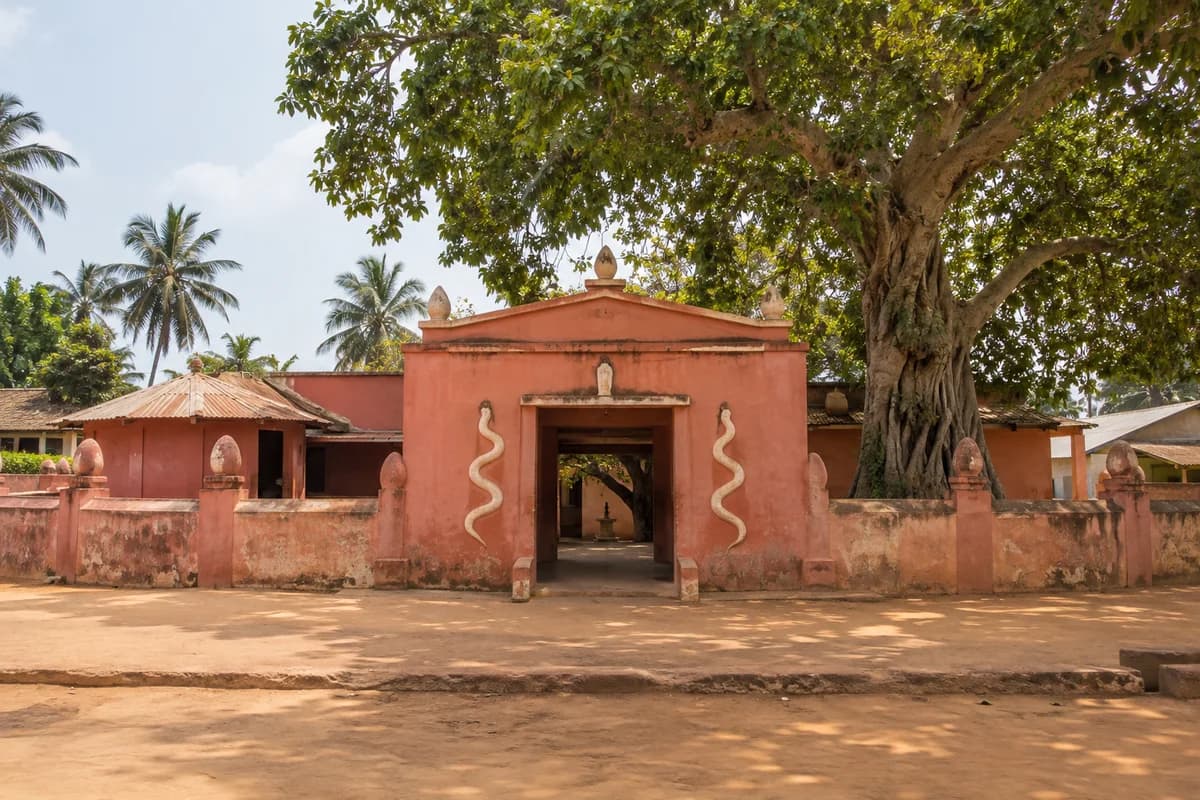
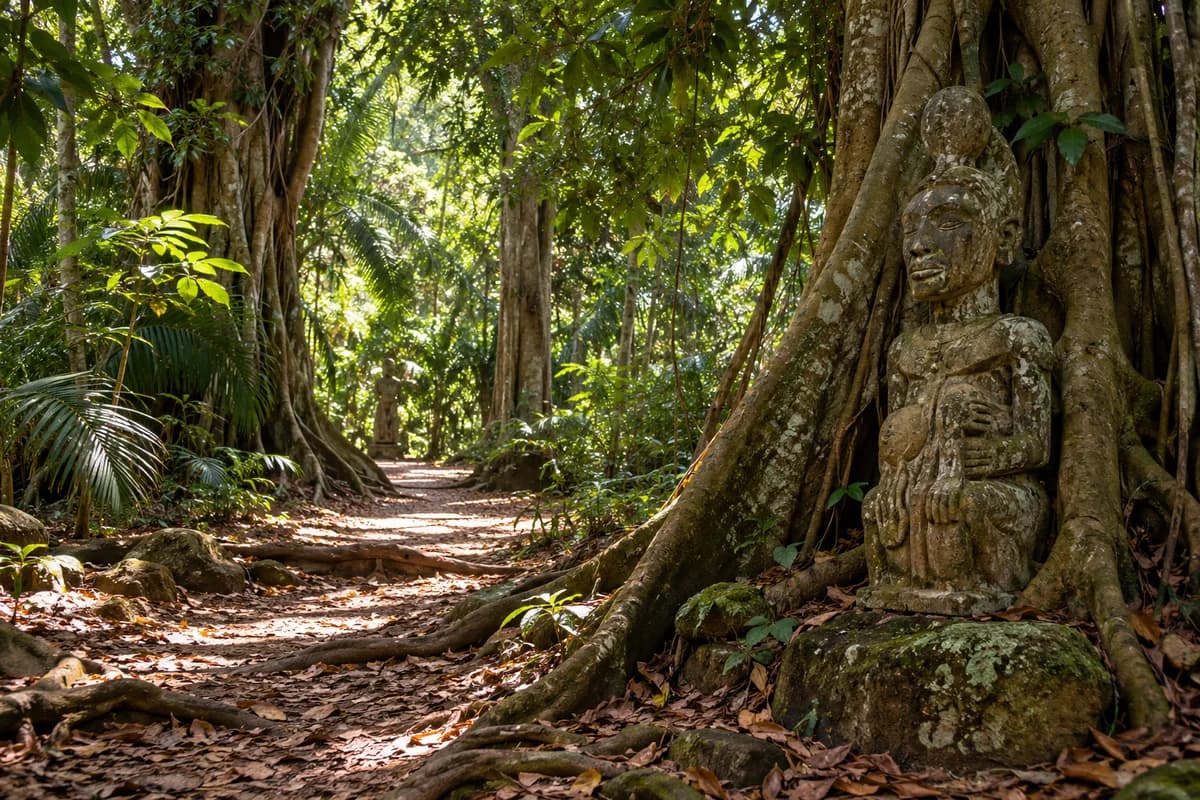
On the edge of central Ouidah, Kpassè Sacred Forest is a green island devoted to the Vodun deities. According to tradition, King Kpassè, founder of the Xwéda kingdom, vanished here and was reborn in an iroko tree. Open to the uninitiated since the Ouidah 92 festival, it is also an open-air museum.
The legend of Kpassè Sacred Forest
The forest takes its name from King Kpassè. Tradition holds that he was the second king of Savi and the founder of the Xwéda kingdom, which ruled the Ouidah region before its conquest by the Fon kingdom of Danxomè.
According to the account passed down by the guardians of the site, the king vanished mysteriously one day. He is said to have reappeared in the trunk of an iroko tree at the heart of the forest. Since then the tree and the surrounding woodland have been held sacred.
Kpassè's iroko still stands at the most sacred spot in the forest, wrapped in white cloth. Visitors traditionally make a wish there.
Sources disagree on the date of this legendary episode. It belongs to oral tradition rather than written history.
Ouidah 92 and opening to visitors
Long reserved for initiates, the forest opened to the public for the Ouidah 92 festival. Launched by President Nicéphore Soglo in April 1992 with UNESCO support, the festival eventually took place from 8 to 18 February 1993.
Its aim was to restore the standing of Vodun worship, long kept out of public life. Delegations came from Haiti, Cuba, Brazil, the United States and Europe. The Kpassè forest was one of the sites chosen for the event.
Artists received commissions for works linked to Vodun, among them Cyprien Tokoudagba and Calixte Dakpogan. Since then the forest has been both a place of ritual and an open-air museum of contemporary art.
What to see
Along the paths, more than twenty statues depict Vodun deities and figures. Many are the work of Cyprien Tokoudagba (1939-2012), a Beninese artist whose work has been exhibited abroad.
- Lègba and Tolègba, guardians and messengers.
- Hêbiosso, the thunder deity, sometimes shown as a couple.
- Sakpata, linked to the earth and to disease.
- Gu, deity of iron and war.
- Mami Wata, deity of the waters.
- Zangbéto, guardian of the night.
At the heart of the wood stands King Kpassè's sacred iroko. The guide tells the legend there and explains the rites held at the site.
Meaning and conservation
The forest remains a living place of worship. Several deities are established there and major ritual ceremonies are held at intervals.
It is also a pocket of nature within the town. Surveys have recorded 36 plant species from 20 families, including medicinal plants. Squirrels, bats and snakes can be seen there.
The forest originally covered about 30 hectares. As the town has grown, only about 4 remain, now entirely surrounded by housing. Its conservation is an important issue for Ouidah.
Did you know?
Among the forest's trees is a false kapok tree around four centuries old. Legumes and the mulberry family, to which the iroko belongs, are the best represented plant families.
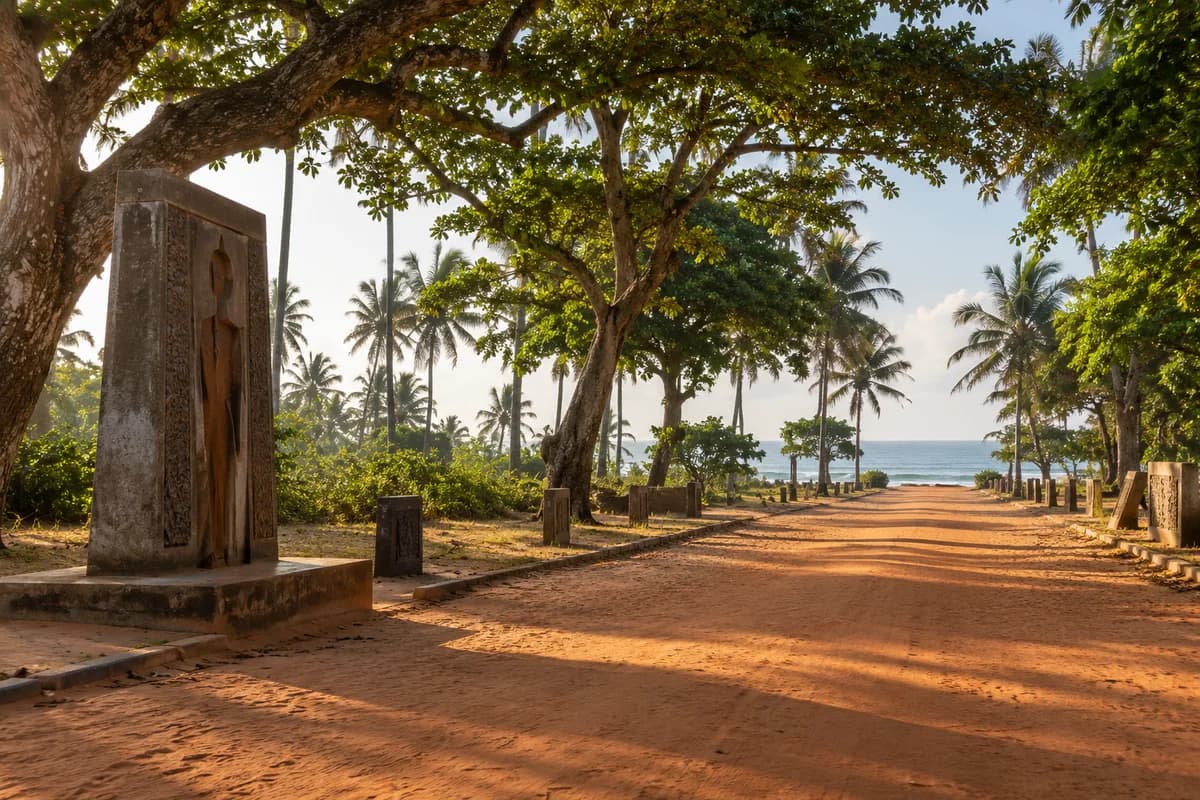
The Ouidah 92 festival also gave rise to the Slave Route, a 3-kilometre trail with six symbolic stations between the town and the beach. The Kpassè forest and the route are often visited on the same day.
Since it opened, the forest has welcomed visitors from many countries in Africa, Europe, the Americas and Asia. They include visitors from France, the Netherlands, Haiti, Brazil, the United States and China.
Planning your visit
Visits are led by a guide on site, who explains the statues and rites. The forest is a sacred place: do not touch altars or offerings, follow the guide's instructions and ask before taking photographs. Wear closed shoes and protect yourself against mosquitoes. No official opening hours or prices are published online: ask on site or at the Ouidah tourist office.
Opening hours and prices can change: check locally or with the tourist office before you go.
Sources
- Matin Libre : la forêt sacrée de Kpassè, un riche patrimoine à préserver (20 août 2024)
- Cultures & Patrimoines : les statues de la forêt sacrée de Kpassè expliquées
- Ouidah Origins : The Sacred Forest of Kpassè
- Wikipédia : Forêt sacrée de Kpassè
- Wikipédia : Festival Ouidah 92
Checked in September 2026.