Pendjari National Park covers north-western Benin, along the river of the same name and the border with Burkina Faso. It is part of the W-Arly-Pendjari Complex, inscribed on the World Heritage List in 2017, one of the last great refuges for savannah wildlife in West Africa.
History of Pendjari National Park
The former hunting area in the bend of the Pendjari became a partial wildlife reserve in 1954, then a national park in 1961. In 1986 UNESCO designated it a biosphere reserve under its Man and the Biosphere (MAB) Programme.
Benin placed the park on its Tentative List in 2009. In 2017 the World Heritage Committee extended W National Park of Niger, inscribed in 1996, into a transboundary property: the W-Arly-Pendjari Complex, shared by Benin, Burkina Faso and Niger.
In May 2017 the Beninese government signed a long-term management agreement with the NGO African Parks. The park is one of the flagship projects of the national investment programme launched in 2016.
Landscapes and wildlife
The W-Arly-Pendjari Complex covers 1,714,831 hectares and brings together nine protected areas. UNESCO describes it as the largest continuum of terrestrial, semi-aquatic and aquatic ecosystems in the West African savannah belt. It includes grasslands, shrub and wooded savannah, open forests and gallery forests.
The Pendjari River, which gave the park its name, forms its northern boundary, facing Burkina Faso. UNESCO describes a system driven by the alternation of dry and wet seasons: the rise and fall of the water creates a wide variety of habitats, plants and animals.
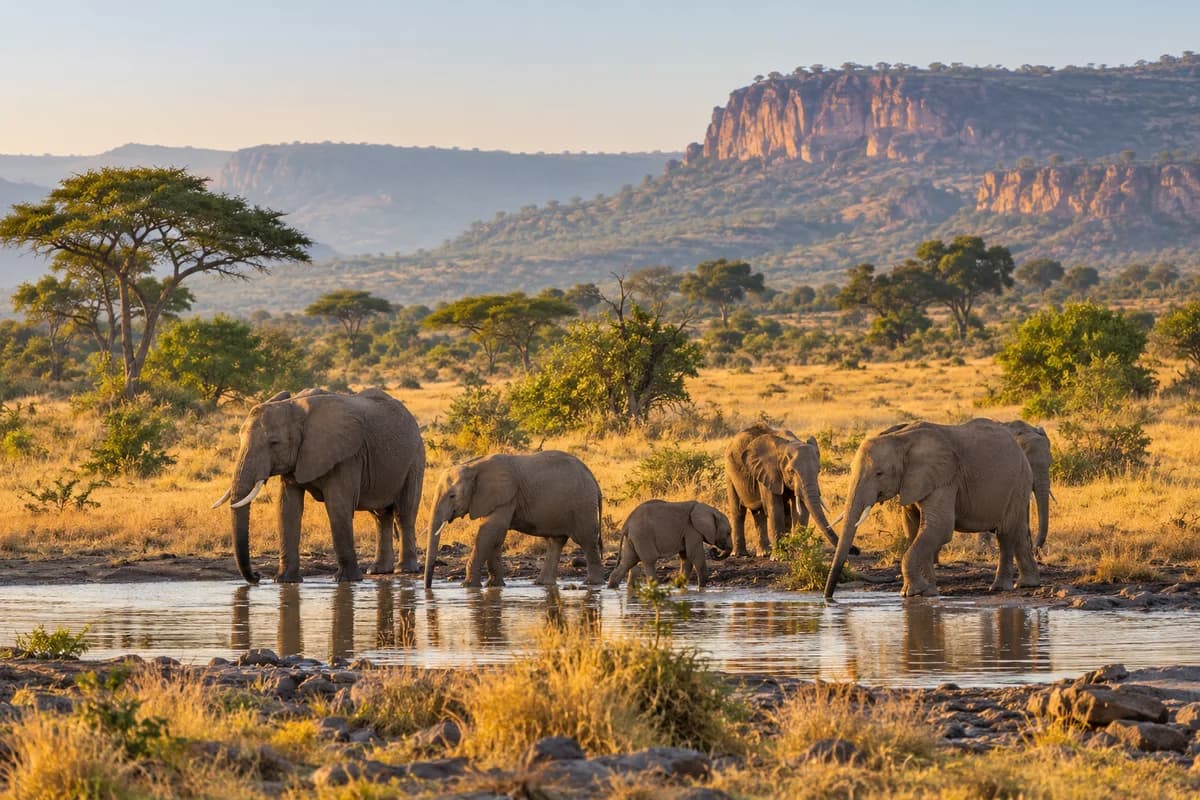
Within Pendjari itself, UNESCO notes the semi-deciduous forest of Bondjagou, a rare formation. The complex holds the largest elephant population in West Africa and most of the region's large mammals:
- lion, including the only viable population in the region;
- cheetah, leopard and African wild dog;
- African manatee and topi antelope.
According to African Parks, about 2,800 elephants live in Pendjari, out of some 4,000 across the whole complex.
Conservation and communities
African Parks reports that wildlife populations are beginning to grow and stabilise, and that the use of natural resources is now managed. The park employs people from the region and supports education and healthcare in neighbouring villages.
In 2024 more than 9,600 schoolchildren and 4,000 residents took part in environmental education. Conflicts between wildlife and local people fell by 70% thanks to fencing and other measures, and more than 5,000 native trees were planted. Beekeeping and soya growing bring new income to hundreds of households.
Did you know?
- The W-Arly-Pendjari Complex lies in the Volta basin and is home to seven of the nine endemic fish species recorded there.
- According to UNESCO, the use of fire linked to human presence, perhaps for some 50,000 years, has shaped the savannah vegetation.
- According to African Parks, the network of parks to which Pendjari belongs holds 90% of West Africa's lions.
Planning your visit
The park extends across the communes of Tanguiéta, Matéri and Kérou, in the Atacora. African Parks acknowledges the ongoing security challenges in this region. As of its update of 2 September 2026, Belgium's Federal Public Service Foreign Affairs advises against all travel north of the line linking Boukoumbé, Toucountouna, Kérou, Kandi and Nikki, the area in which the park lies. Before making any plans, read the Belgian travel advice and register your trip on Travellers Online. Opening times, prices and access conditions are provided only by the park's managers.
Opening hours and prices can change: check locally or with the tourist office before you go.
Sources
- UNESCO, Complexe W-Arly-Pendjari (fiche 749)
- UNESCO, Programme MAB, réserve de biosphère de la Pendjari
- African Parks, Pendjari (Bénin)
- Wikipédia, Parc national de la Pendjari (dates de 1954 et 1961)
- SPF Affaires étrangères, sécurité générale au Bénin (mise à jour du 2 septembre 2026)
Checked in September 2026.