Luc Gnacadja
Luc Gnacadja serves as Mayor of Cotonou in the Republic of Benin.
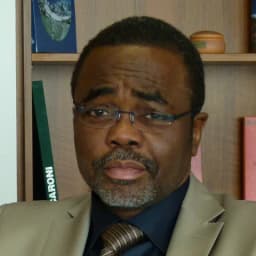
An architect, former Minister of the Environment and former Executive Secretary of the UN Convention to Combat Desertification, Luc Gnacadja has been mayor of Cotonou since February 2026.
Education and career
Born on 19 October 1958 in Porto-Novo, Luc-Marie Constant Gnacadja is an architect, a graduate of the African School of Architecture and Urban Planning (EAMAU) in Lomé.
From June 1999 to February 2005, under President Mathieu Kérékou, he led the Ministry of Environment, Housing and Urban Planning. In 2003, the World Bank gave him its Green Award for action in favour of sustainable development. After standing as the Envol movement's candidate in the 2006 presidential election, he was appointed in 2007 Executive Secretary of the UN Convention to Combat Desertification (UNCCD) in Bonn, a post he held until 2013.
Mayor of Cotonou
Following the municipal elections of 11 January 2026, Luc Gnacadja succeeded Luc Atrokpo at the head of the economic capital. The prefect of Littoral installed him on 15 February 2026 for a seven-year term, with Arlette Saïzonou, Gatien Adjagboni and Irène Béhanzin as deputies.
On 18 August 2026, the congress of the National Association of Municipalities of Benin (ANCB), meeting in Cotonou, elected him as its president.
The municipality of Cotonou
The country's economic capital, Cotonou is home to the Autonomous Port, most government services and diplomatic missions, and the Dantokpa market, one of the largest in West Africa.
Cotonou lies in the Littoral department, of which it is the capital. The municipality covers about 79 km² and had 679,012 inhabitants at the 2013 general census (RGPH-4), compared with 665,100 in 2002. That is growth of 2% and a density of about 8,595 inhabitants per km².
The municipality is divided into 13 districts (arrondissements): 1er arrondissement, 2e arrondissement, 3e arrondissement, 4e arrondissement, 5e arrondissement, 6e arrondissement, 7e arrondissement, 8e arrondissement, 9e arrondissement, 10e arrondissement, 11e arrondissement, 12e arrondissement and 13e arrondissement.
Sources: INSAE (2002 and 2013 censuses), Wikipedia.
Who is Luc Gnacadja?
Politically, Luc Gnacadja belongs to the Union progressiste le Renouveau (UP-R) party.
The term of office began on 15 February 2026 and ends on 6 February 2033.
This profile first explains the role, then how to send a request from Belgium through the Honorary Consulate of Benin in Liège.
The role of Luc Gnacadja
Chosen by the municipal council from among its members, the mayor heads the administration of the municipality of Cotonou. Luc Gnacadja therefore implements the council's decisions, prepares and executes the municipal budget and represents the municipality.
The mayor is also the civil registrar: the municipality's birth, marriage and death certificates are drawn up under the mayor's authority. Moreover, since the decentralisation of 2003, municipalities have managed local planning, markets, roads, sanitation, and the building and upkeep of primary schools and basic health centres.
For the Beninese diaspora in Belgium, the town hall therefore remains the natural contact for a civil status matter, a project in one's home municipality or a local procedure.
Sending a request to Luc Gnacadja from Belgium
Do you live in Belgium and wish to submit a question, a difficulty or a proposal to Luc Gnacadja? The consulate then forwards your request through official channels, without comment.
The consulate remains neutral, whatever the political affiliation of the authority. In addition, your name reaches the authority only with your consent; otherwise, the request stays anonymous.
- First, create your personal account on this website or sign in.
- Next, write your request: the subject, the facts and what you expect from the authority.
- Then the consulate reviews the request against the charter before forwarding it.
- Finally, you follow each step from your account and receive any reply that comes back.
Frequently asked questions
How can I contact Luc Gnacadja from Belgium?
No public contact details appear on this profile yet. The simplest option is therefore a request through the consulate, which forwards it through official channels and keeps you informed.
What should a request include?
Set out the facts, what you expect from the authority and, where relevant, the steps you have already taken. For a member of parliament or a mayor, also mention your home municipality in Benin: this helps the authority to place your request in context.
Which requests does the consulate decline?
The consulate sets aside insulting, defamatory or threatening language as well as electoral propaganda. It may also group similar requests together or decline those that breach the charter; in that case, it tells you why.
Does the consulate reply on behalf of the authority?
No, because the authority remains free to reply and the consulate cannot guarantee an answer. However, it passes on any reply it receives, directly in your personal account.
Is this information official?
No, it serves as a guide for the diaspora. In case of doubt, only the texts published in the Official Journal of the Republic of Benin are authoritative.