The Royal Palaces of Abomey are the historic heart of the Kingdom of Dahomey (Danxomè), one of the most powerful states of pre-colonial West Africa. Twelve kings reigned over this site of around 47 hectares, from the 17th century to the end of the 19th. Today, this World Heritage property is undergoing a major transformation. Here is what you need to know before you go.
A World Heritage Site since 1985
UNESCO inscribed the Royal Palaces of Abomey on the World Heritage List in 1985, under criteria (iii) and (iv). That same year, the site also joined the List of World Heritage in Danger, because a violent tornado had badly damaged the buildings in 1984.
For over twenty years, the Beninese State therefore carried out restoration work with several international partners. The bas-reliefs, in particular, went through a long conservation programme. In 2007, the World Heritage Committee finally removed the site from the Danger List, while asking Benin to continue its efforts.
In practice, the property brings together some ten palaces built side by side. Indeed, each new ruler built his own residence next to his predecessor's, inside a vast enclosure of earthen walls. For the wider context, see our History page.
Twelve kings, one dynasty
Tradition counts twelve kings of Dahomey, the first of whom belong partly to legend. The Royal Palaces of Abomey mainly bear the mark of the following rulers:
- Houégbadja (c. 1645-1685), seen as the true founder of the kingdom and of its first palace;
- Akaba, then his twin sister Tassi Hangbè, whose memory long stayed out of the official accounts;
- Agadja, who conquered Allada and then Savi in the early 18th century, so opening access to the coast and Ouidah;
- Ghézo (1818-1858), who reformed the State and the army, including the corps of women warriors;
- Glèlè (1858-1889), whose emblem is the lion;
- Béhanzin (1889-1894), a symbol of resistance to the French conquest, whose emblem is the shark;
- Agoli-Agbo (1894-1900), the last king, installed under a French protectorate.
In November 1892, as Colonel Dodds's troops approached, Béhanzin had part of the city set on fire. After his surrender in 1894, France exiled him to Martinique and then to Algeria, where he died in 1906. To learn more about the kingdom's women fighters, read our guide to the Dahomey Amazons.
What you will see on site
Since 1943, the Historical Museum of Abomey has occupied the palaces of Ghézo and Glèlè. It holds thrones, récades (royal sceptres), weapons, appliqué hangings and ritual objects. However, the greatest treasures of the Royal Palaces of Abomey remain their polychrome bas-reliefs in modelled earth.
Walls that tell a story
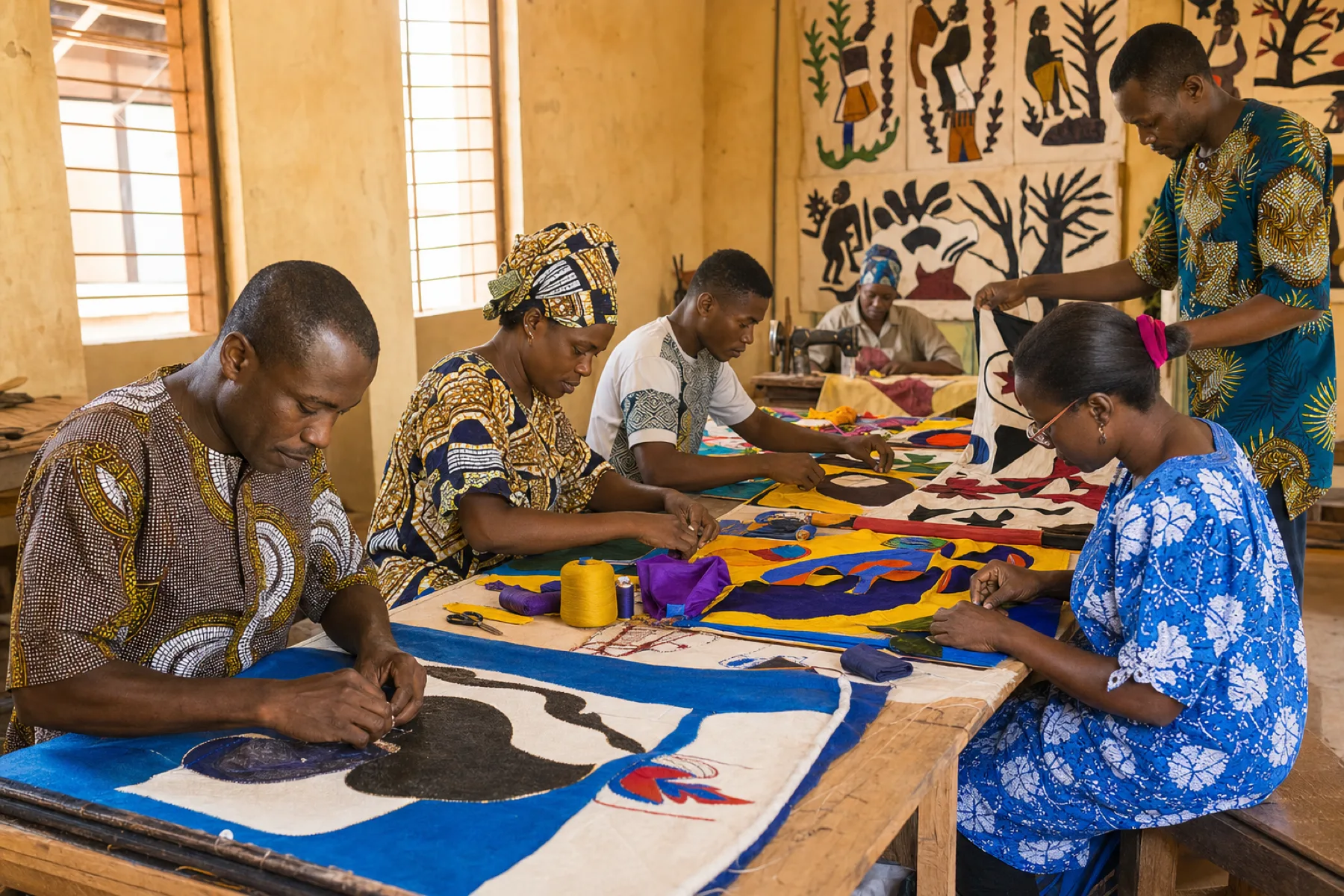
These bas-reliefs are a true form of picture writing. They depict victories, royal mottos, deities and court life. For example, Glèlè's lion and Béhanzin's shark recall the strong names each ruler chose. The appliqué hangings, sewn by families of Abomey craftspeople, repeat the same symbols in bright fabric.
Around the enclosure
Beyond the museum, the city has other palaces, temples and historic squares. For instance, Goho Square is home to a statue of Béhanzin. In addition, local workshops sell hangings, bronzes and wrought-iron pieces.
The MuRAD museum project
Since 2021, a vast programme has been under way to enhance the Royal Palaces of Abomey. On 3 June 2021, Benin and the French Development Agency (AFD) launched the project, with funding of 22.95 billion CFA francs, or 35 million euros. Benin's national heritage and tourism agency (ANPT) leads it, with support from Expertise France and the French Ministry of Culture.
The programme has several strands:
- restoring the palaces of Ghézo, Glèlè, Béhanzin, Agoli-Agbo and Akaba;
- building the Museum of the Kings and Amazons of Danxomè (MuRAD) to international standards;
- restoring part of the enclosure wall and creating a heritage trail across the site.
Eventually, the MuRAD will house the 26 royal treasures that France returned in 2021. On this topic, read our feature on the return of the Abomey royal treasures. However, the schedule has slipped. In April 2026, the head of the presidential mission for museums mentioned a possible opening in spring 2027. The authorities will announce the official date.
Planning your visit
- Access: Abomey lies about 150 km north of Cotonou, next to Bohicon. Allow at least half a day for the return trip.
- Works: the historical museum closed in 2024 for the building work. So check which palaces are open before you set off.
- Guided tour: hire an approved guide, because the symbols of the bas-reliefs are hard to read without explanations.
- Formalities: remember your electronic visa and your vaccinations.
To build a complete itinerary, see our Visiting Benin page and our selection of 15 must-visit places.
Frequently asked questions
Can you visit the Royal Palaces of Abomey during the works?
Only in part. Some areas remain open, while others are closed for the building work. Ask locally or check with a local agency before you travel.
How much time should you allow?
Half a day is enough for the main site. If you also want to see the other palaces and the workshops, plan a full day instead.
Where are the treasures returned by France?
Since their return in 2021, they have remained in storage at the Marina Palace in Cotonou. Their permanent home will be the MuRAD in Abomey, once the museum opens.
Keen to follow in the footsteps of the kings of Dahomey? Honorary Consulate of Benin in Liège makes your departure easier: apply for your e-Visa online and get in touch through the Contact page for any practical question.