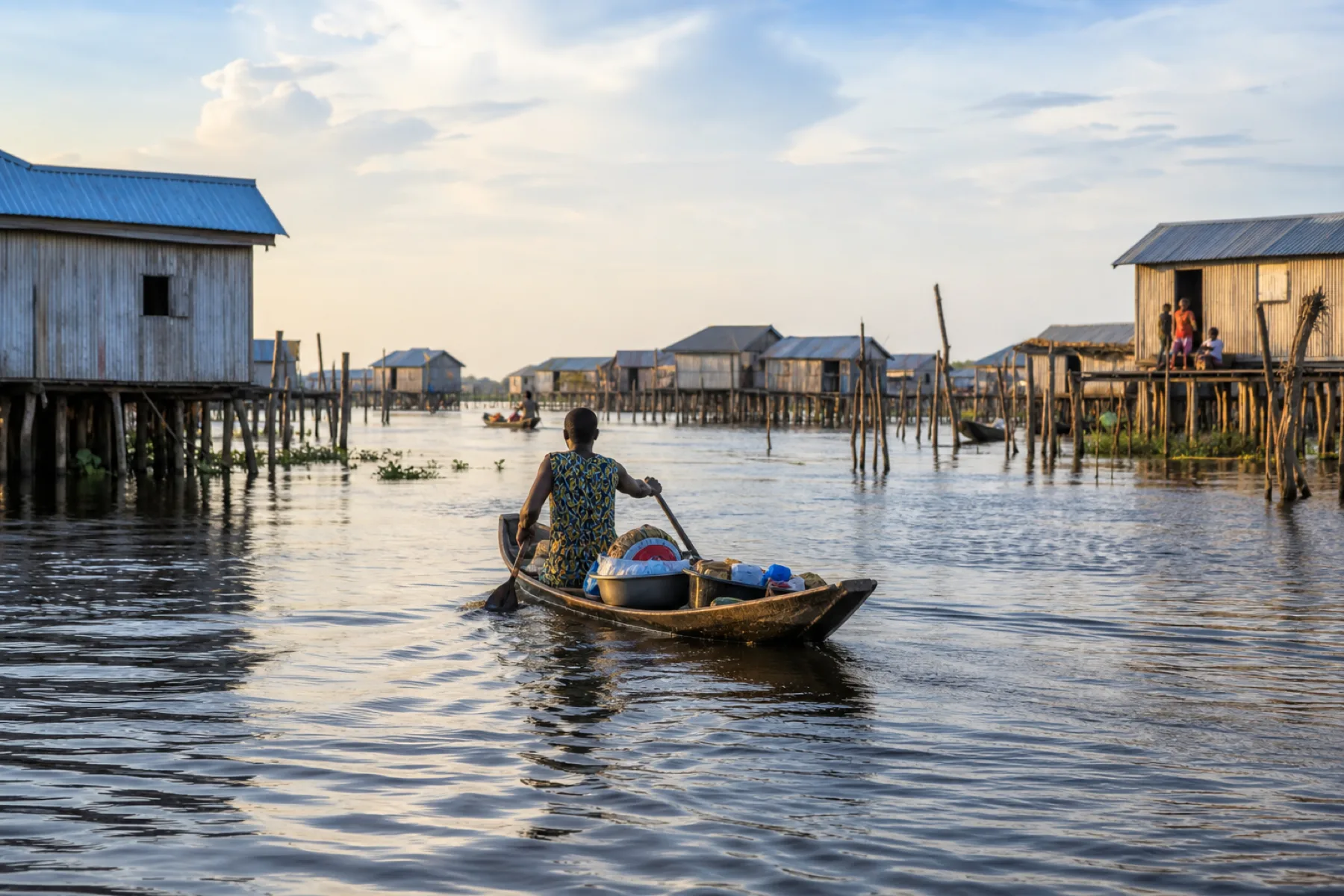
Ganvié lake village stands on Lake Nokoué, about twenty kilometres north of Cotonou. Thousands of stilt houses, canoes laden with fish and a floating market have earned it the nickname “Venice of Africa”. Yet Ganvié is no stage set: it is a living town, home to tens of thousands of people. Here is its story, its daily life and our advice for discovering it with respect.
A town built on water to survive
Ganvié dates back to the 17th or 18th century, depending on the source. At that time, warriors of the kingdom of Danxomè captured entire communities to sell them to European slave traders in Ouidah. So the Tofinu people took refuge in the marshes of Lake Nokoué. According to tradition, a religious rule forbade the warriors of Abomey from fighting on water.
The name Ganvié is often translated as “we survived”. It thus recalls this founding choice. To place the episode in the history of the slave trade, also read our feature on Ouidah and the Slave Route. Today, the town belongs to the municipality of Sô-Ava, in the Atlantique department.
Daily life in Ganvié lake village
Here, everything happens by canoe: going to school, shopping, visiting the neighbours. The wooden and bamboo houses stand on stilts, often under a roof of metal sheets or thatch. Women run a floating market where fruit, vegetables and fish pass from one boat to another.
Fishing remains the main activity. In particular, residents use acadja, enclosures of branches planted in the lake. These branches attract fish because they offer shelter and food. However, population pressure, pollution and silting weaken this system. Access to drinking water and electricity also remains a daily challenge.
Planning your visit to Ganvié lake village
First, trips start from the Abomey-Calavi jetty, north of Cotonou. Then a motorboat or a canoe takes you to the first houses. The official Bénin Tourisme portal suggests allowing two to three hours on site.
| Stage | Approximate time |
|---|---|
| From Cotonou to the Abomey-Calavi jetty | 30 to 45 min, depending on traffic |
| Lake crossing by motorboat | About 30 min, longer by canoe |
| Tour of the districts and floating market | 1 h 30 to 2 h |
Arrange your crossing at the jetty with an approved guide, or book through a recognised agency. Also agree on the price of any service before you board. In the morning, the light is softer and the market is at its busiest. Finally, bring a hat, water and sunscreen, since there is little shade on the lake.
Visiting with respect
Ganvié is first and foremost a place where people live. So always ask before you photograph someone, and accept a refusal with a smile. Some residents expect a small contribution for a photo, so settle this with your guide in advance. Likewise, buy crafts or a meal on site rather than handing out money to children.
If you speak a few words of Fon or Tofin, the welcome will be even warmer. Our article on the languages spoken in Benin gives you a few pointers.
Exploring further around the lake
Ganvié is not the only lake settlement in the area. Other villages in the municipality of Sô-Ava also live on the water, and they are often quieter and less visited. Besides, you can easily combine the trip with a day in Cotonou or in Porto-Novo, the capital, some thirty kilometres away. Finally, if you love waterscapes, also keep time for Lake Ahémé and the Bouche du Roy, further west.
Ganvié in 2026: protection and major works
On 4 March 2026, the government listed Ganvié lake village as national cultural heritage, through decree no. 2026-057. This status now regulates construction and development, in order to preserve the site's integrity. In addition, Ganvié has featured on Benin's UNESCO World Heritage tentative list since 1996.
Meanwhile, the “Reinventing the lake city of Ganvié” project, funded by the French Development Agency (AFD), plans connections to drinking water and electricity. It also includes the rehabilitation of a jetty in Abomey-Calavi and the dredging of channels. These works fit the tourism strategy described in our article “Bénin, un monde de splendeurs”.
Frequently asked questions
Where is Ganvié lake village?
On Lake Nokoué, in the municipality of Sô-Ava, north of Cotonou. You reach it by boat from the Abomey-Calavi jetty.
How much time should I allow?
Plan on half a day from Cotonou, travel included. On site, two to three hours are enough for a first visit.
Why is it called the “Venice of Africa”?
Because its streets are canals and the canoe replaces the car. Still, Ganvié has a history and culture all of its own.
When is the best time to go?
You can visit Ganvié all year round. However, the dry season is the most pleasant, as our guide to the best time to visit Benin explains.
Ganvié deserves a place on any Benin itinerary, alongside the sites in our selection of what to see in Benin. Before you leave, apply for your e-visa on the official portal. For any question, contact Honorary Consulate of Benin in Liège.
Sources
- Bénin Tourisme: official page on Ganvié
- General Secretariat of the Government: Council of Ministers report, 4 March 2026 (French)
- French Development Agency: “Reinventing the lake city of Ganvié” project (French)