The National Conference of 1990 remains the founding event of modern Benin. Meeting in Cotonou from 19 to 28 February 1990, delegates of the "active forces of the Nation" peacefully turned the page on the revolutionary regime and laid the foundations of a multiparty democracy. Here is how it came about, what it decided and what remains of it today.
A regime running out of steam
Since 1972, the country had lived under the rule of Mathieu Kérékou. The regime claimed to follow Marxism-Leninism and rested on a single party, the People's Revolutionary Party of Benin. By the late 1980s, however, the crisis had become general. State banks collapsed, civil servants waited months for their pay and students staged strike after strike.
On 6 and 7 December 1989, a joint session of party and state bodies therefore took two major decisions. First, the regime dropped Marxism-Leninism as its official doctrine. Second, it agreed to call a national conference. On 22 December 1989, a preparatory committee chaired by minister Robert Dossou began its work. To place this period in a longer perspective, read our feature on the political history of Benin.
Ten days at the PLM Alédjo hotel
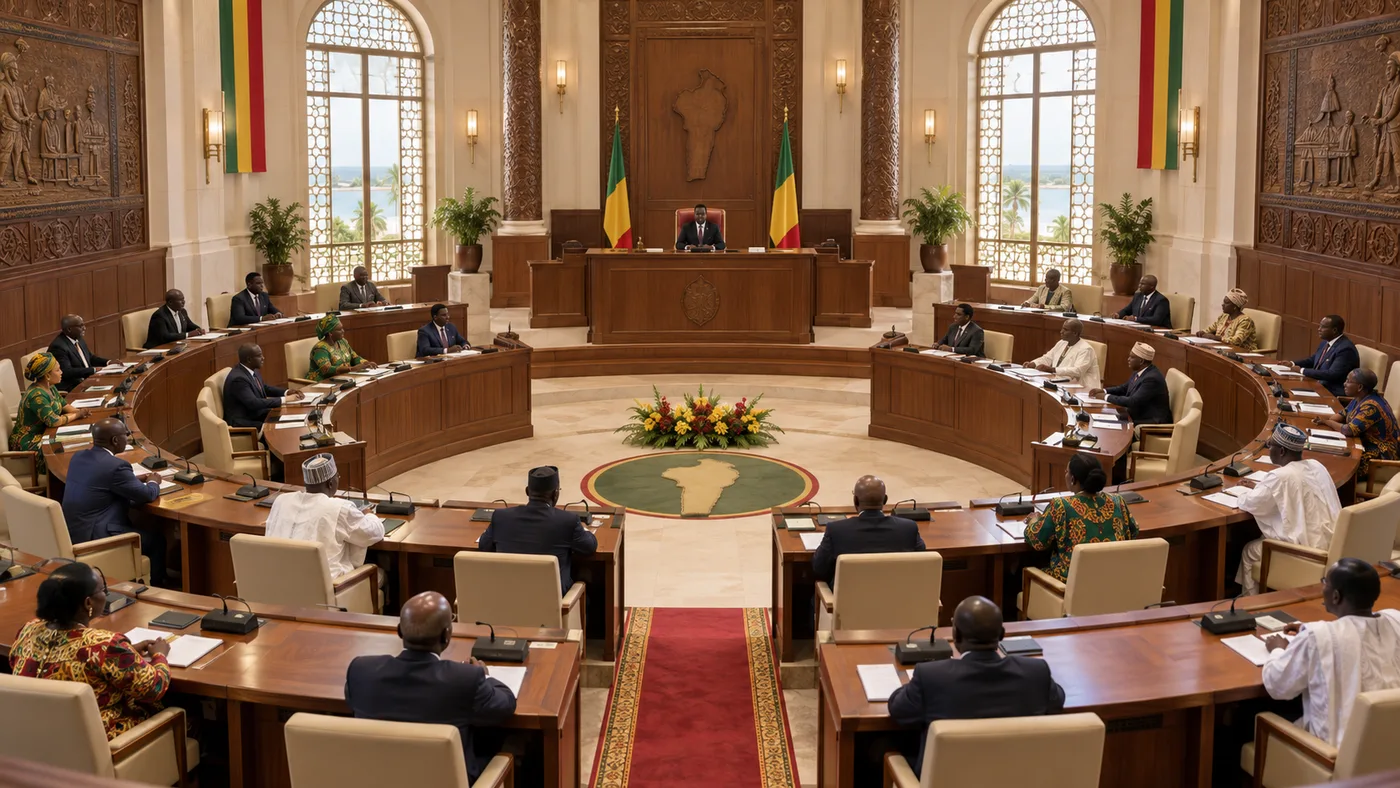
Proceedings opened on Monday 19 February 1990 at the PLM Alédjo hotel in Cotonou. Nearly 500 participants represented political parties, trade unions, farmers, the civil service, faith communities and development associations. Archbishop Isidore de Souza, coadjutor archbishop of Cotonou, chaired the debates, while Professor Albert Tévoédjrè served as general rapporteur.
Very quickly, the National Conference of 1990 refused to remain a mere advisory body. Thus, in a declaration dated 24 February 1990, it proclaimed its sovereignty and the binding force of its decisions. The text won 372 votes in favour, 17 against and 17 abstentions. Faced with this choice, President Kérékou avoided a showdown and accepted a compromise.
Key decisions of the National Conference of 1990
After ten days of debate, delegates adopted a set of measures that mapped out the transition:
- the 1977 Fundamental Law was repealed;
- from 1 March 1990, the country once again took the name Republic of Benin;
- Nicéphore Soglo, an economist with a World Bank background, became prime minister of a transitional government;
- a High Council of the Republic, chaired by Archbishop de Souza, acted as an interim parliament;
- an independent commission would draft a new constitution, to go before voters in a referendum.
Mathieu Kérékou stayed on as head of state until the elections, but with reduced powers. This unusual power-sharing arrangement helped avoid a violent rupture. At the closing session on 28 February, the general report captured the mood of the delegates in a famous phrase: "We have overcome fate".
From transition to the December 1990 Constitution
The High Council of the Republic took office on 9 March 1990. Next, the constitutional commission, led by the jurist Maurice Ahanhanzo Glèlè, adopted its draft on 9 August. After months of debate, voters approved the text by referendum on 2 December 1990. Then, on 11 December 1990, the Constitution entered into force.
Finally, the legislative elections of February 1991 and the presidential election of March 1991 completed the transition. In the run-off on 24 March, Nicéphore Soglo defeated Mathieu Kérékou, who accepted the outcome. This peaceful change of power gave full meaning to the process launched a year earlier.
A model for French-speaking Africa
Widely regarded as the first national conference in French-speaking Africa, the Beninese experience soon inspired the region. Gabon held its own as early as 1990. In 1991, Congo, Mali, Niger and Togo followed the same path, then Zaire. However, the results varied greatly from one country to another.
In Benin, the legacy of the National Conference of 1990 is still visible. Indeed, the Constitution of 11 December 1990, revised in 2019 and 2025, still underpins today's system. Our guide to the institutions of Benin shows how it works now, and our page on politics and institutions sums up the essentials.
Frequently asked questions
Why is it called a "sovereign" conference?
Because delegates declared their decisions binding, without prior approval from the government of the day. As a result, the meeting went well beyond the advisory role first planned.
Who chaired the National Conference of 1990?
Archbishop Isidore de Souza, then coadjutor archbishop of Cotonou, led the debates. He later chaired the High Council of the Republic during the transition.
When does the resulting Constitution date from?
Voters approved it on 2 December 1990, and it took effect on 11 December 1990. It remains in force after the revisions of 2019 and 2025.
Who became president after the Conference?
Nicéphore Soglo, prime minister of the transition, won the presidential election of March 1991. He then served a five-year term, until 1996.
This episode belongs to the shared memory of all Beninese people, including those in the diaspora. To explore other chapters of the country's past, visit our page on the history of Benin. For your paperwork, such as a consular card or the legalisation of documents, Honorary Consulate of Benin in Liège can help through our contact page.
Sources
- University of Perpignan, MJP: sovereignty declaration of 24 February 1990 and transition timeline
- La Nation: remembering the Conference of the Active Forces
- Les 4 Vérités: the general report of the February 1990 Conference
- Wikipedia: Benin's sovereign National Conference