Understanding the institutions of Benin helps you follow news from the country and know which authorities stand behind your paperwork. Since the Constitution of 11 December 1990, revised in 2019 and again in 2025, Benin has been a presidential republic built on the separation of powers. This guide presents each body, its role and its make-up, without jargon.
A framework set by the 1990 Constitution
The current constitution grew out of the National Conference of February 1990. Voters approved it by referendum on 2 December 1990, and it enshrines multiparty politics, civil liberties and judicial review. Since then, two revisions have reshaped the system.
- The revision of 7 November 2019 created the office of vice-president, the Court of Auditors and the principle of general elections. It also bans the death penalty.
- The revision enacted on 17 December 2025 set up a Senate, extended elected terms to seven years and introduced a political truce between elections.
Overall, the institutions of Benin fall into three groups: the executive, Parliament and the courts. In addition, several advisory and regulatory bodies complete the picture. Here are the main office holders in September 2026.
| Institution | Head in 2026 |
|---|---|
| Presidency | Romuald Wadagni |
| Vice-presidency | Mariam Chabi Talata |
| National Assembly | Joseph Djogbénou |
| Senate | Patrice Talon |
| Constitutional Court | Dorothé Sossa |
The executive: a president with a seven-year term
The President of the Republic is both head of state and head of government. As a result, Benin has no prime minister. Voters choose the president by direct universal suffrage for a seven-year term, renewable once. Moreover, nobody may serve more than two presidential terms in a lifetime.
Since 2019, a vice-president has run alongside the president on a joint ticket. If the presidency falls vacant, the vice-president then serves out the remainder of the term. Romuald Wadagni has held office since 24 May 2026, with Mariam Chabi Talata as vice-president. He leads a 24-member government, presented in our article on the 2026 presidential election and the first Wadagni government.
At the heart of the institutions of Benin: a two-chamber Parliament
The National Assembly
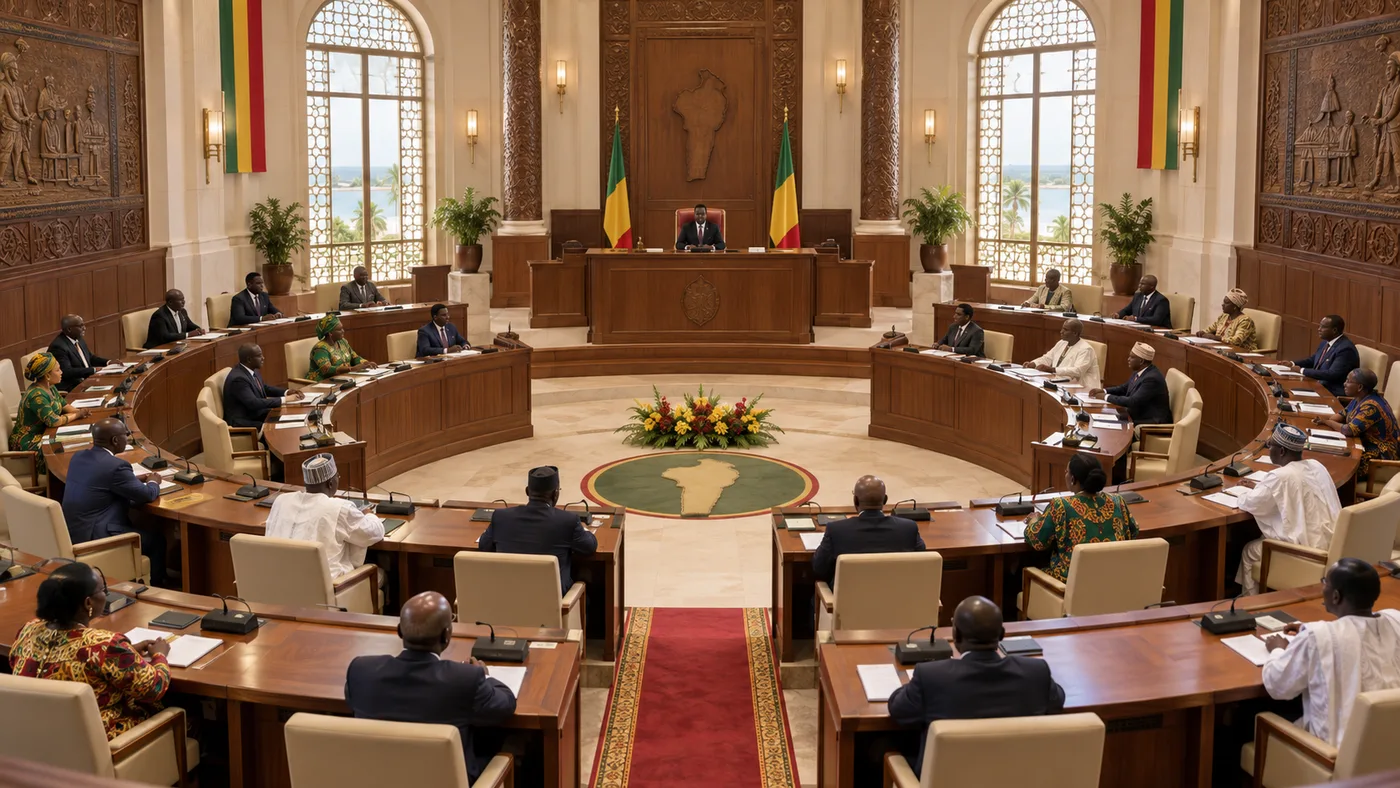
Sitting in Porto-Novo, the National Assembly passes laws, approves taxes and scrutinises the government. It has 109 members, elected for seven years by direct universal suffrage. The latest legislative elections took place on 11 January 2026. Then, on 8 February 2026, the members of the 10th legislature chose Joseph Djogbénou as their speaker.
The Senate, a chamber created in 2025
The Senate brings together ex officio members, such as former presidents of the Republic, and appointed figures. Its first term has 25 members. After its inauguration on 30 July 2026, it chose Patrice Talon as its president on 6 August. Its main task is to regulate political life and safeguard national unity. For instance, it can request a second reading of certain laws, except finance laws. For details, read our article on the inauguration of the first Senate.
The courts, guardians of the rule of law
Among the institutions of Benin, the Constitutional Court plays a central role. It has seven judges: the bureau of the National Assembly appoints four and the president appoints three, for five years. The Court reviews whether laws comply with the Constitution and protects fundamental rights. It also declares the final results of the presidential election.
Alongside it, the Supreme Court remains the highest court in administrative and judicial matters. Meanwhile, the Court of Auditors, created by the 2019 revision, oversees public finances; its president took the oath on 7 May 2021. Finally, the High Court of Justice can try the president and ministers for high treason or for offences linked to their duties.
Advisory and regulatory bodies
Other bodies complete the system. First, the Economic and Social Council gives its opinion on economic and social projects. Next, the High Authority for Broadcasting and Communication (HAAC) protects press freedom and fair access to public media. In addition, the Autonomous National Electoral Commission (CENA), set up under the Electoral Code, runs elections and publishes provisional results.
On the ground, the state also relies on twelve prefects, one per department, and on 77 municipalities headed by mayors. Our guide to the departments of Benin and their capitals explains this structure, while the territorial development poles reform shows how it is changing.
Frequently asked questions
Who leads the government in Benin?
The President of the Republic leads the government in person. Indeed, the Constitution provides for no prime minister, so ministers act under the president's authority.
How many chambers does Parliament have?
Since the Senate's inauguration in July 2026, Parliament has had two chambers. However, only the National Assembly comes from a direct popular vote.
Where do the institutions of Benin sit?
Porto-Novo is the official capital and hosts the National Assembly as well as the Senate. By contrast, the presidency and most ministries operate from Cotonou.
Who announces election results?
First, the CENA publishes provisional results. Then the Constitutional Court declares the final results of presidential and legislative elections.
For a short overview, see our page on politics and institutions, and our feature on the political history of Benin traces how this system took shape. For your paperwork, Honorary Consulate of Benin in Liège is here to help: browse our consular services, apply for your consular card or reach us through our contact page.
Sources
- Constitutional Court of Benin: members of the Court
- National Assembly of Benin: official website of Parliament
- Court of Auditors of Benin: history of the institution
- SRTB: what the 2025 constitutional revision changes
Article tags